Showing posts with label Heath. Show all posts

Thursday, February 8, 2024

Waterman and Heath

It has long been known that Waterman purchased overlays from George W. Heath & Co. A number of early Watermans bear silver overlays with the Heath "H" mark, and though the mark is absent on later examples, the continuity of style and workmanship strongly suggests continuity of sourcing. The same pattern of marking is seen with other penmakers using Heath overlays, and it is reasonable to suppose that all eventually chose not to give their subcontractor free advertising -- especially as Heath began to manufacture and sell fountain pens under their own name around this same time. It is not known why the Heath mark only appears on the silver overlays and never on gold filled or solid gold examples, even though their common source is clearly evident.

Nearly ten years ago I wrote the following about Heath's operations from the mid-teens onwards:

While the company continued to offer items under the Heath name, by all evidence the bulk of its business lay in contract manufacturing. Quantity of surviving examples isn't always a reliable gauge of quantities produced, but in this case the contrast between the scarcity of Heath-branded pens and pencils and the size of the factory and workforce is too stark to ignore. I strongly suspect that Heath continued to be the prime supplier of high-quality overlays to the US fountain pen trade as long as overlay pens continued to be made. In particular, Heath was probably the maker of all of Waterman's overlays -- early electrodeposited fine silver examples a possible exception -- from around the turn of the century all the way to the end of overlay pen production at some point in the 1930s. Waterman often publicized its production methods, and in some detail, yet never in any of these accounts is there any mention of in-house manufacture of overlays.

This speculation about the company's later history must now be amended, as there is good evidence that Waterman was manufacturing overlays in-house by at least the beginning of the 1920s. This is found in the description of Waterman's newly completed and occupied factory in Newark, New Jersey, published in the American Stationer of March 26, 1921 on p. 11 (and subsequently republished in other periodicals, such as Pacific Ports, June 4, p. 158, and India Rubber World, August 1, 1921, p. 840). The factory was notable for both its size and the horizontal integration of operations, including ink production and the distribution of dealer display material. On the third floor was the "gold and silver mounting department" and on the second, the "chasing and ornamental mountings department" -- "mountings" being the contemporary term for what we call overlays (also used to denote trim bands, but in this context clearly referring to overlays as well). I have not been able to find any mention of such departments in earlier Waterman factories, but for now this should be taken as absence of evidence rather than evidence of absence. 

What was Heath doing at this time? In my 2014 post I noted that "The later history of Heath is particularly obscure, with many of the usual online sources unavailable in volumes postdating the 'teens." Yet it was clear that the company was moving in new directions in the early 1920s: 

The brothers were already diversifying . . . while they held a number of patents, the latest that has anything to do with writing instruments is US 1514965 (an extending pencil), applied for in 1922. All subsequent patents, starting with US 1605723, also applied for in 1922, are radio-related, and from the 1923 Newark city directory on, we find the Heath Radio and Electric Manufacturing Company ("radio parts and condensers") listed alongside George W. Heath & Co. at the same address. 

While the (possibly older) company letterhead still proclaimed George W. Heath & Co. "Manufacturing Gold and Silversmiths" as well as "Patentees and Sole Manufacturers of Heath's "Tribune" Pencils and Fountain Pens" in a receipt dated October 26, 1923, the company had also placed a wanted ad a year before in The Iron Age seeking to buy a screw machine -- a large investment and a clear commitment to automated mass production.

In retrospect, my interest in Heath's overlay work led me to underestimate the extent of their pen and pencil manufacturing operations. It should have been clear that Heath was moving into manufacturing in a big way in the 1910s -- mass production, not artisanal hand work -- and I have recently found further corroboration of how early this started in the April 19, 1911 testimony of Hobart W. Geyer in the legal battle between Waterman and the Modern Pen Company, appealed all the way up to the US Supreme Court. On p. 1419 of the record, Geyer is asked, "Have you been in any factory during the last three years?" to which he answers, "I have been in Heath's several times in that time." "What kind of factory is it?" he is asked, to which he answers, "They make rubber holders and they make mountings." On the following day another witness, gold nib maker DeWitt C. Van Valer, also mentions Heath's factory in an exchange recorded on p. 1517. "When were you in Mr. Heath's factory?" "Within the past year." "Mr. Heath is a comparatively new man in the manufacture of rubber holders, is he not?" "I think he has been turning holders to my knowledge for the last four years, and may have been turning them before that." This lines up with the change in how Heath's business was described in directories of the time, from chasing and gold and silver novelties to fountain pens and pencils. This also lines up with the expansion of Heath's workforce and the move to a new factory in New Jersey in 1912. The demand for hand-worked gold and silver was declining, not growing: it wasn't the traditional bench jewelers leaving New York for New Jersey, but rather the manufacturing firms that required ample floor space for large machine tools and multistep production operations.

At this point we can only speculate about what happened in the 'teens and early 1920s, as Heath moved away from handwork and Waterman brought overlay manufacture in-house. I have found no record of workers moving from Heath to Waterman, let alone a formal transfer of a whole department. But skilled workers in the pen trade often moved from company to company, as is shown repeatedly in the testimonies cited above. And with Heath and Waterman's Newark factories only a little over a mile apart -- neither unionized -- continuing cooperation at some level can by no means be ruled out.

Friday, August 7, 2020

Greek nib breaththrough


It's now been several years since I posted on a mysterious group of early 20th-century American-made pens with Greek imprints. Not having worked on them in the interim, it was an especially pleasant surprise to have received this note from my fellow pen enthusiast Panos, reproduced here in full with his permission and my gratitude:


Dear David,

I hope you are keeping well in these difficult times.

I'm writing you because I believe that I can offer a humble contribution to your blog on the subject of the "Greek Nib" pens article
(https://vintagepensblog.blogspot.com/2013/05/greek-nib-followup.html).

I actually read your article for the first time a couple of years ago (or perhaps more), but it was only recently that I decided to do a little research of my own on the subject. After all, speaking the Greek language provides a certain advantage in such cases…

After completing my research, I can safely say that the reason, for which you were unable to discover any information on these pens, is that you are looking for the wrong name…. But, let us look into this in detail.

Indeed the pens in question were produced by the Kritikaki Brothers, which appear to have been active members of the Greek community in N.Y., and many of their customers must have been fellow Greek New Yorkers of the time. I have no information for a potential reseller in Greece, for these pens, but I suppose that Greek-Americans of the time may have brought their pen(s), or some pens as presents to relatives and friends, back to Greece on one of their visits. One way or another, this explains why one of the pens mentioned in your article, was "rediscovered" in Greece.

Now, it was more than often the case (and still is) that immigrants changed their names as part of their integration to the society they lived in. After all, the number of native English speakers that can properly pronounce Greek names must be minute in our days, and certainly, back then, in the beginning of the 20th century N.Y., it must have made the grand total of…. none at all. And this is, admittedly, not good for business… So, among the Greek community the company was known as the "ΑΔΕΛΦΟΙ ΚΡΗΤΙΚΑΚΗ" (Kritikaki Brothers), but to the general American public, they were the... "KRITIKSON BROTHERS" or "KRITIKSON BROS."! And although the Greek flags and the references to Beautiful Greece must have appealed to the customers from the Greek-American community, they also had pens for the rest of the American public.

But let's look at the actual evidence…

The weekly magazine "Η ΝΙΚΗ" of 17/08/1913  (The title means "The Victory" and we have to note that during the period of 1912-1913 Greece and its neighbours were awfully busy fighting the Balkan Wars, and thus both the title and many articles of the publication seem to depict this). I also like the typo in the title page (which only exists in this particular issue of the magazine, so it is indeed a typo) : "PUBLISHED BY THE GREEK BUBLISHING CO."

So, in its second [to] last page we have the advertisement for the model No 58, a black chased pen, featuring two gold plated bands with the Greek and the American flag. By the way "ΜΕΛΑΝΟΦΟΡΟΣ" actually means that the pen carries its own ink, and not that it has a black cladding. The thing that probably confused you is that the ancient (but also the modern) Greek word for "ink" comes from the ancient Greek word for "black", probably because the ink of the old times used to be always black…. But perhaps the most intriguing fact is that the advertisement states that their catalogue (which they are happy to send to you for free) contains 75 different kinds (of pens)!
By the way, I believe that you are right about the pen featuring King Constantine I. It must have been a  commemorative edition, for the accession of the king to the throne. He was also very successful in leading the Greek army during the Balkan Wars, and thus he must have been very popular among the Greeks in general. You can also see him on page 3 of the same magazine above "commanding an officer of his entourage".

Now, things become more interesting in this advertisement from the N.Y. Greek newspaper "ΑΤΛΑΝΤΙΣ" ("Atlantis", first appeared in 1894), from the 1st of January 1914. Here the Kritikson Brothers propose gifts from the new year's day (Greeks traditionally exchanged gifts on the first day of the new year, and not on Christmas) and it has a list of different models, including No 58.
I shall try to translate the model descriptions - Note that the description is using the word "jewel" where - I suppose - we would use the words "pattern" or "design" these days :

No 182. GOLD DECORATED. Gold plated with bright bands. $4.50
No 444. FLOWER DECORATED. Gold decoration with jewels depicting clover. $6.00
No 312. CLUSTER DECORATED. Gold plated in its entirety with clusters of colourless Greek and American flags. $6.50
No 121. GOLD BAR DECORATED. Gold plated in its entirety with clusters of bars. $7.00
No 484. FLOWER DECORATED. Gold plated in its entirety with jewels of orange tree flowers. $7.50
No 390. RIBBON DECORATED. Gold plated with ribbon like jewels. $6.50
No. 642. FLOWER WREATH DECORATED. Gold plated with wreaths of flowers and
branches. $9.00
No 560. VARIOUS DECORATIONS. Gold plated with various different jewels. $9.00
(Number missing) FLOWER DECORATED. Gold decorations with jewels depicting violets (Viola odorata). $6.50
No. 58. Black chased with two beautiful gold plated bands on which the Greek and the American flags are engraved $2.50 - With only one band $1.50. (note here that in the 1913 advertisement, the price of $1.50 was without any bands).
No. 805. Gold plated in its entirety, with square jewels.
No. 810. Gold plated in its entirety with jewels of squares and flowers.
No. 815. Gold plated in its entirety with jewels depicting stars.
No. 800. Gold plated in its entirety with jewels depicting flowers (which look suspiciously like fleur-de-lys, in other words, lilies).

Finally, and as all the pens appear to be clipless, the note at the end reads "Clip for the protection of the pen, gold plated 50c, nickel 15c".

Also, notice the nibs of the pens. I see mainly three different versions: - One with the letters A K, standing for the Greek version of their name ("ΑΔΕΛΦΟΙ ΚΡΗΤΙΚΑΚΗ"). - One with the letters K B, standing for the English version of their name ("KRITIKSON BROTHERS") - And the ones featuring all or some of the following: the Greek flag, the words "Η ΩΡΑΙΑ ΕΛΛΑΣ" (The Beautiful Greece), and the initials A K.

So far so good. But what happened to the Kritikson Brothers of New York? Well, it seems that they became the Kritikson Brothers of Chicago, and that they concentrated on producing their patented SECURITY PEN. I suppose that it was a good idea, as it would be very difficult to compete with companies like Waterman and Parker….

So, their Security Pen patents were filed between 1919 and 1921…
https://patents.google.com/?assignee=KRITIKSON+BROS+Inc

Security pens do not feature the Greek flag nibs, of course, and in the English language advertisements there is no mention of the Greek name of the brothers or anything like that…..

But, have a look at this advertisement in the Atlantis of 1921, providing the missing link…
The advertisement has the title "Where can I get one?", referring to the wonderful "SECURITY" CHECK PROTECTOR PEN, and, after enumerating the awesome features related to the pen (mechanism, nib, feeder and clip), it goes on to say "All the above features are PATENTED INVENTIONS of (the) Brothers Kritikaki, having 17 years of experience in this field and having founded, three years ago, the company "SETTLES PEN COMPANY" with a capital of $250,000. The factory is one of the largest and one of the most perfect in America, with annual production of 500,000 pens." It goes on to mention a provided 5-year warranty and prices of the pens. Interestingly, the pens were also available without the CHECK PROTECTOR, in which case they were lowered by $1.00. It also says that they  are seeking for partners in America and abroad.

So, we also learn that the Kritikaki Brothers were related to the SETTLES pens as well! And their 17 years experience means that they were involved in the fountain pen manufacturing since 1904!

Alright, I think this is enough research for this week! Surely this info does answer a good number of questions, and you may feel free to use it to expand your original article. On my side, I am glad that I seem to have discovered a previously unknown (?) Greek contribution to the fountain pen saga. Sadly, none of the Kritikakis Brothers' pens have made it to my
limited collection so far. Perhaps one day…

Regards,
Panos.


As noted in the previous articles, the pens offered by the Kritikson/Kritikaki Brothers during their early years in New York were made by other companies, such as Aikin Lambert and Eagle. It was only later that they began manufacturing on their own.

For those delving into the later history of the brothers, this account is found on p. 104 of Walden's Stationer and Printer, vol. 45 (November 1921), describing a tour of the factory by the former Prime Minister of Greece. The brothers are described as "native Greeks". For some reason Settles is misspelled as "Settels" throughout this volume.
In the following issue (December 1921, p. 64) there is some further biographical information on the brothers. Of particular interest is the mention of them buying "a few job lots of seconds from the factory which they assembled at home in the evening". From the phrasing it is not entirely clear, but it would seem to be saying that the seconds came not from Waterman, where John worked, but from the other, unnamed factory where George was employed.


Thursday, April 7, 2016

Unger Brothers, rebranding, and mass production in the pen trade


A cluster of Unger Brothers items recently came our way, which prompted a consultation of our reprint copies of the 1904 Unger catalog and the 1905-6 supplement. The pens don't figure very prominently, unfortunately, but the perusal was extremely rewarding for a very different reason. Though I had surely read it before, the introduction to the second reprint (Ulysses Grant Dietz, "Variety, Affordability, Modernity", The Unger Bros. Supplementary Catalogue, 1905-1906, Cincinnati, 1999) explains the company's market position in terms that are directly applicable to those manufacturing jewelers catering more specifically to the writing equipment trade. The following passage should help shape our understanding of both the marketing of generic precious metal dip pens and mechanical pencils, and that of fountain pen overlays (Heath's position, in particular):
You must keep in mind that these catalogues were not available to the general public. No consumer could possibly have sifted through the dizzying array of forms and patterns. This awesome assortment of elegant goods was aimed at the myriad retailers, large and small, who would select from it a smaller range that would be right for their particular market. A Chicago wholesaler, for example, might select a couple hundred different items that it thought it could then sell to small retail outlets in the mid- and far-west. An established local retailer, on the other hand, would select an even smaller assortment, perhaps fifty different items. These it would mix with other selections from other manufacturers, creating a product line that was unique to its own store. In this way, individual retailers created an identity of their own that was based on other manufacturers' products. 
A case in point is Daniel Low & Co., established in Salem, Massachusetts in 1867 as the local jeweler-silversmith. By 1893 they had begun their own mail-order venture, and by 1901 claimed to be the largest mail-order dealers in gold and silver in the country. Their 168-page retail catalogue for that year includes silver made by many different manufacturers, including numerous pieces drawn from Unger Brothers' line. . . .
Consumers who bought goods from the Daniel Low catalogue probably had a vague sense that they were buying from the silversmith himself -- and that's just what Daniel Low wanted. The Unger Brothers name meant nothing to the average consumer. Only in Newark itself, where Unger maintained a retail outlet in its factory for local shoppers, did the name mean something.
Grant notes that there were over 4000 different items on offer between the 1904 catalog and the 1905-6 supplement, and that wholesale prices were strikingly low. Coincidentally, I had recently stumbled across an article in the American Stationer (vol. 36, Dec 6, 1894, p. 1038) about Unger Brothers pitching the companies' products to the stationery trade.
There is a wrong impression among stationers that the prices of sterling silver goods are high, but we want to say that there is little difference between the the prices of the plated article and the article of genuine sterling silver. In short, we take the articles which are carried by many stationers and improve and beautify them. We mount them in a sterling finish, make them available for the finest stationers trade, and at a cost only slightly advanced over the plated article.
The full passage is much longer, also mentioning Unger trying out an ad, shown below, which appears two pages previous (p. 1036).


Unger Brothers' range and volume was vastly greater than that of the more specialized manufacturers working behind the scenes of the pen and pencil industry. Since hardly any Unger catalogs have survived, it should not be cause for surprise that no catalogs have yet turned up for manufacturers of overlays, or for the makers of all those unbranded and rebranded pens and pencils we spend so much time puzzling over.

Wednesday, October 1, 2014

A late Heath magic pencil


What at first glance appears to be an unprepossessing silver golf pencil, turns out, with a pull on the end, to be a magic pencil -- and one made by the fabled firm of George W. Heath & Co.


It's no accident that its styling recalls the streamlined golf pencils of the 1920s and '30s, for this is a very late magic pencil. The design, with the screw-off lead reservoir shown below, was the subject of US patent 1,514,965 -- the very last of Heath's writing equipment patents. The application was submitted on July 19, 1922 and the patent was issued on November 11, 1924. The "PAT. APP. FOR" imprint locates the pencil between those two dates.


The pencil is also of interest in that it bears both of the standard Heath marks. The famous H in a square is on the extending shaft, while "G. W. H. CO." appears on the barrel. The Heath marks stop appearing on the overlays of name-brand pens well before this pencil was made -- suggesting that the omission of the marks from contract work was customer, not Heath's, choice.


Saturday, March 22, 2014

George W. Heath & Co.

 
Heath is a name well known to pen collectors -- though less for their own pens and pencils than for the overlays they supplied to some of the most prominent American penmakers at the beginning of the 20th century. Heath overlays are found on the pens of Waterman, Parker, Conklin, Moore, A. A. Waterman, Carey, and others, yet little is currently known about how the companies worked together, or for how long. Some Heath articles can be identified by a maker's mark, the most common of which is an "H" in a square, the square with two short lines extending right and left -- but this mark is only seen on silver, never on gold or gold filled items, even those in all other ways identical to their silver equivalents.

A much less common variant is an "H" in a spiky diamond, as shown below, also found only on silver.

The mark below is not restricted to silver objects, but I have never seen it applied to a fountain pen overlay. It seems most common on gold filled pencils.


This post will concentrate on Heath's earlier history. A good starting point is a rather boosterish volume published in 1912, Newark, the City of Industry. On page 116 we find the picture above, and the following entry:
IN the year 1892, George W. and Alfred C. Heath began business as partners in New York as "chasers and designers to the trade." The original location was at 137 Elm street, New York, but owing to increasing business more commodious quarters were obtained at 27 Thames street, and later at 380, 382 and 384 Canal street.

In May, 1912, desiring to avail themselves of the splendid manufacturing facilities afforded by Newark, and being disposed to do their share in making Newark famous, and proving that "Newark Knows How," the firm of George W. Heath & Co. moved the office and factory to the modern fireproof structure which they had erected at 206, 208, 210 First street.

The company is engaged in the manufacture of fountain pens, and in these days of universal education when everybody can write, there is an ever increasing demand for its product.

The pens made by this concern are known as Heath's Tribune Fountain Pens, the component parts of which are made of the best material obtainable, and are carefully assembled and adjusted by skilled men under the direct supervision of the members of the firm.

Besides fountain pens the company also manufactures gold pens, gold and silver pencils and art metal goods which are sold all over the world, through agencies established by correspondents and frequent visits of traveling salesmen among the dealers in various foreign countries.

All products that are made by this company bear the imprint "Made in Newark," and the goods are worthy of the city in which they were made.
This outline history is consistent with the other records I have consulted. In the Twelfth Annual Report of the Factory Inspector of the State of New York, submitted Jan 24, 1898, p. 260, "Heath Bros." is listed as engaged in "Silver chasing", with 5 employees. The following year's report (p. 272) is the same, but with 4 employees. The report for the year following, 1899 (p. 313) is shown below (the space between the Heaths' listing and the header has been trimmed for ready reference).

Monday, December 23, 2013

A special-order Heath pencil


As soon as I put up the pictures of my Heath clutch pencils, a colleague wrote to ask about the one at the bottom -- in particular, the inscription at the top of the barrel, just below the crown. It reads, "Every Pound Pulls". This was the slogan used by the Concrete Steel Company of New York City to promote its patented "Havemeyer Bar" -- one of a number of competing forms of metal reinforcing bars used in reinforced concrete construction of the era.


The ad above (Engineering News-Record, vol. 69, Jun 19, 1913, p. 90) nicely illustrates its form, which is replicated in the relief patterning of the pencil's barrel and crown band.


PS Heath also made "Every Pound Pulls" dip pens; a nice boxed example was shown in an October 2024 Facebook post in the Antique Writing Instruments group.

Wednesday, December 18, 2013

Who designed the Eversharp pencil?

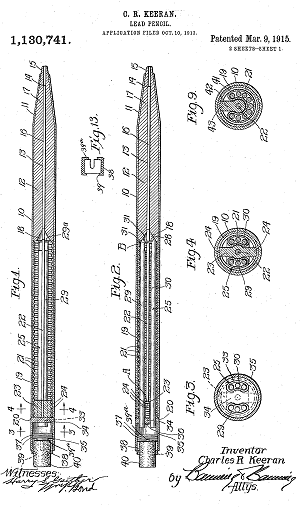
Up until recently, the answer would have seemed straightforward: Charles R. Keeran invented the Eversharp; the design must have been his. But as Jonathan Veley has pointed out, the appearance of the pencil shown in Keeran's first pencil patent is very different from our idea of an Eversharp. Instead of a metal tip, there is a wooden core, while at the other end there is an exposed eraser. Optional eraser covers are mentioned, but the designs shown in no way resemble the classic Eversharp's distinctive crown. All in all, this proto-Eversharp is most un-Eversharp in appearance. Note that no actual example of such a pencil is known, and the patent application for it was filed October 13, 1913.


The advertisement above was published in The Insurance Press of December 1912 (p. 83). By Keeran's own account, this was shortly before he first began thinking about an improved mechanical pencil. It would have been several months before his pencil patent application, and a full year before the first Eversharps were produced -- by Heath, by all evidence.


As the ad and the examples above show, Heath's clutch pencils have the Eversharp look, with the same proportions and the same distinctive crown. I had always thought that these pencils postdated Heath's involvement with Keeran. My reasoning was based upon the assumption that the Eversharp design was Keeran's, and that after Keeran and Heath parted ways, Heath must have borrowed the design for Heath's own pencils -- albeit only for pencils with a clutch mechanism, which clamped the lead, and did not mechanically push it out. Perhaps some components were left over from Heath's manufacturing work for Keeran, and perhaps some hadn't been paid for, allowing Heath to use them with a clear conscience -- or so I speculated.

The Insurance Press ad turns this all upside-down. Keeran invented the Eversharp's internals, but its "skin" was borrowed from a preexisting Heath product. We may never know exactly how Keeran's mechanism ended up being put into the Heath clutch pencil's body.  It might have been Keeran's idea; it might have been suggested by Heath while discussing how best to put Keeran's pencil into production. In any case, the resulting hybrid ended up eclipsing its progenitor. Heath likely didn't mind much, so long as it was producing both. Once Keeran switched production to Wahl it might have been a different story, but by then it was probably too late for Heath to do anything. I have not been able to find any patent for the Heath clutch pencil, either design or utility, even though one example, shown below, is marked "PAT. APP. FOR" on the barrel. This may explain why Wahl was in turn unable to prevent competitors from offering pencils that copied the Eversharp's appearance -- their number is striking, as is the closeness of resemblance.

ADDENDUM: More on the last pencil in the group of four shown in the picture above here.

Friday, June 14, 2013

A very special overlay

Even though they were manufactured in large quantities, filigree overlays required a great deal of hand work. Still, it is notable how minor the variations are from example to example -- and how rarely one finds a truly custom-made specimen. This pen is a Heath Tribune, a known model with a gold filled overlay identical to that supplied to Parker for its #16 pens. The cap overlay on this particular pen, however, was specially made to incorporate a monogram into the filigree pattern. Coincidentally, my friend Luiz recently acquired a very similar Parker 16, also with a monogram worked into the cap filigree pattern.

Wednesday, May 8, 2013

Greek nib followup


A couple of months back I posted a request for information about an American-made nib with a Greek imprint. I can now reveal that the nib (shown again above) was found on the pen shown below, which came directly from a family house on a Greek island.
Perhaps more useful in tracking down the origin of these nibs, however, is the pen shown below: an eyedropper with an Aikin Lambert nib, and to all appearances of Aikin Lambert manufacture, but with a Greek barrel imprint and a wide band at the top of the cap with a portrait of King Constantine in enamel.
Constantine I reigned from 1913 to 1917, and again from 1920 to 1927. The design of the pen, the presence of a V. V. clip in particular, suggests that it was made to commemorate the accession of 1913.
The barrel imprint is shown above. Between two Greek flags, it reads: "ΕΛΛΗΝΙΚΗ ΜΕΛΑΝΟΦΟΡΟΣ ΠΕΝΑ/ΑΔΕΛΦWΝ ΚΡΗΤΙΚΑΚΗ NEW YORK" (Greek black-clad [correction: "ink-holding"] pen/of the Brothers Kretikaki, New York). There can be no doubt that the "A. K." on the mystery nib stands for Αδελφων Κρητικακη -- the Kretikaki (or Kritikaki) Brothers.
The same barrel imprint is also found on a pen recently sold on eBay which also bears a fancy enameled band at the top of the cap, this one with the Greek flag. The nib bears the same ΩPAIA/EΛΛAΣ imprint as the snake pen, with the "A. K." below.

To add one more example to the series, yet another nib is shown below. Its imprint is slightly different: the Greek flag is not present, nor is the article "H" in front of "ΩPAIA".

There are no other imprints on the pen that bears this nib, which is shown above. Like the other pens in this group, it once had a V. V. clip (the mounting holes in the cap are distinctive), and while it is of excellent quality, it clearly was made by one of the smaller penmakers: possible candidates would include Aikin Lambert, A. A. Waterman, Carey, Eagle, and Wirt.

As yet I have not been able to find any trace of any Kretikaki or Kritikaki brothers in New York, excepting a record of an 11-year-old Autigony Kritikaki passing through Ellis Island in 1908. There is a Kritikaki Brothers company in Greece that is currently active in tile and other construction materials, and perhaps it would be worth contacting them to inquire about the history of their company.

ADDENDUM: Yet another report of a fancy pen with the same nib, this one a Heath silver filigree over red hard rubber. Although our sample size is still very small, the great variety of pens is striking. No two are alike, and the main commonality is that they are all flashy, of excellent quality, and made using components that were generally available in the greater New York City fountain pen industry. This suggests that the Kritikaki Brothers were not aiming to sell large quantities of a limited selection of designs, but rather to offer a broad range of distinct individual items to a boutique clientele. I would further speculate that this business came to a crashing halt with the start of WW1 -- first with the curtailment of shipping, then with the split of Greece into the Kingdom of Greece and New Greece in 1916 -- and that the pens found to date in the United States were inventory stranded and eventually sold off in New York (there is an interesting report from the US Consul in Thessaloniki, published in February of 1917, about the market for fountain pens in New Greece, but if one looks at contemporary reports from New York, availability of shipping to Greece could not be counted upon).

UPDATE: After seven years, the answer is at hand! Read all about it here.