Showing posts with label Wahl-Eversharp. Show all posts

Monday, February 12, 2024

Erasers for vintage Eversharp pencils


When it comes to old writing instruments, the least standardized consumables must be erasers. There are some hard to find lead sizes, to be sure, but the number of different eraser sizes is mind-numbing. Nor is there any comprehensive list of what pencils take what size, though there have been efforts made.

Up until recently I was content to leave erasers to others. Then I stumbled across a hoard of 7mm erasers, which ended up listed for sale. Then I made a video on all-metal Eversharp pencils, part of which involved eraser replacement. So replacement erasers in those sizes (5mm and 1/4 inch) ended up in the catalog. Next came 5.5mm for Snorkels and TM Touchdowns. And now 8.5mm has joined the lineup, the size for the big Eversharp pencils with the exposed erasers, along with the variants with an eraser cover (two of which are shown at the bottom of the photo above).

Tuesday, May 19, 2020


While putting my reference shelves in order, I spent a little time browsing through this 1943 Spors catalog. Spors is best known to American pen collectors as the main prewar importer of cheap Japanese fountain pens, most notably the glass-nibbed crescent-fillers imprinted with the Spors name. With the outbreak of WW2 supplies of these pens were cut off, and this is duly noted on an inside page.


With evident discretion no mention is made of exactly where these pens had been coming from ("present conditions do not permit importations"). One wonders how seriously Spors was actually pursuing the possibility of manufacturing glass nibs on their own. Despite the loss of their Japanese suppliers, Spors managed to find other sources for pens -- which included not just their usual bottom-tier stuff, but also closeout stocks of models prized by collectors today.


Most notable must be the Conklin Nozacs, offered in multiple colors and as sets with matching pencils. The most expensive V-line pens were offered at just $5.95, or $6.90 as a set. By 1943 Conklin lived on in name only, its name affixed to the cheapest of economy pens (some of which appear elsewhere in this same catalog), but these Nozacs were from the company's better days -- and undoubtedly dumped as part of the company's sale and liquidation.


Wahl-Eversharp was still very much in business in 1943, though reorganized under the Eversharp name. They too had liquidated a great deal of older stock a few years before, some of which clearly made its way into Spors' inventory. Though not a top-line model, the Pacemaker shown above was a quality pen with strong Art Deco styling -- not common today, and a collector favorite. In 1943 you could have bought a dozen sets for $42, though for that price you had to make do with a manifold nib.

Thursday, November 24, 2016

Eversharp's original Demi Skyline


Sometimes major discoveries turn up right under our noses. In a recent instance, I was putting together ordinary Eversharp Skylines for sale -- nothing special, just common examples which had accumulated in a shoebox-sized quantity over the years -- and found that one small pen wasn't like the others. The barrel was rather scratched up, so I went through my box looking for a better barrel I could swap in. To my surprise, nothing fit. The small pen wasn't just short, it was also significantly slenderer than every other Skyline I could lay my hands on -- 10 mm over the barrel threads, to be precise, vs the standard 10.6 mm. Normal Demi (also called Ladies) Skylines are shorter than standard-sized Skylines but of the same girth, so caps and barrels will all interchange. My mystery pen was the same length as a normal Demi, yet its parts weren't even close to interchangeable. 

It was clear that the pen was early production, as the section had an ink window and the derby screwed onto a plug threaded into the top of the cap -- both well-known early features. The logical explanation was that this was Eversharp's original Demi Skyline, and that after a short time it was beefed up to match the standard Skyline's girth (the opposite of the Parker 51 Demi, which started out at standard thickness, and which was slenderized for the Aerometric version a few years later). And yet I could find no mention of such a slender model, neither in collector literature, nor in Eversharp catalogs or repair manuals. 

Eventually one collector got in contact to offer me another example, identical but in slightly better condition. Alas, he could not help provide any further information about the model's history. Then at the most recent Ohio pen show, I sought out a collector friend who has had a longstanding interest in Skylines, who was able to sell me yet another example in a different color. He didn't seem overly surprised at my "discovery" -- but at the same time, didn't seem to recognize that this particular model was at all rare.


In the photos of Skyline Demis above and below, the slender versions are the two in the center. Unlike the later pens flanking them, they lack any imprint at the back of the metal ring between the top of the cap and the derby. The difference in girth is not immediately obvious, though clear upon closer inspection.


The slender pens are the bottom two in the photo below, in which the difference in girth is more obvious. The pen on the bottom has a two-tone nib, and it is quite possible that the pen above it originally did as well, for the nib shows considerable usage.

Friday, December 4, 2015

Edward Todd enameled pen puzzle


This Edward Todd came to me recently, bringing to three the number of similar enameled ringtops sitting around the shop (one was profiled here last year). Unlike the other two, which are both lever-fillers, this one is an eyedropper-filler. Like the others, it is fully marked on the end of the barrel. But while the others came with their apparently-original Edward Todd nibs, this one had a Wahl Tempoint nib instead. My first impulse  was to dig out a suitable Edward Todd nib to swap in, but then it struck me that the section profile wasn't right, either, as it was identical to that found on early Wahls and their Boston precursors. Ditto for the feed.

But wait: this pen is an eyedropper, so if this were a Wahl or Boston section, the section's threads would have to match. Yet after digging into my store of Wahl and Boston eyedroppers, I found that the threads don't match. Their dimensions are correct, but while the Wahl and Boston threads are all single-start, the Edward Todd's threads are triple!

From top to bottom: Edward Todd lever-filler, Edward Todd eyedropper, Wahl eyedropper

Why anyone would use triple-start threads for an eyedropper's section joint is beyond me. It makes opening and closing the pen marginally faster, but at the cost of increasing the risk of the section coming unscrewed unintentionally. In any case, there can be little doubt that the section now in my newly-acquired pen is the original. The threads are one indication; the other is the Edward Todd lever-filler shown at the top of the picture above, whose section (press-fit) has a similarly Wahl-like exterior profile -- though the feed is simple and unfinned. So I'm not going to do any switching of sections, feeds, or nibs, though I am now wondering if Edward Todd was purchasing hard rubber components from Wahl or Boston. If so, that still doesn't explain the presence of the Tempoint nib, since Edward Todd consistently used own-marked nibs throughout the company's history. Just a coincidence, a Wahl nib put into a Wahl-made Edward Todd section? If any readers have any other data points, please let me know. I have several other non-enameled Edward Todds somewhere around the house, and when I locate them I'll check to see if any have similar sections or feeds.

NOTE: While Mabie Todd sections can have a similar profile -- a cylinder, a conical taper, and another conical taper -- the cylindrical part is markedly wider than on the Wahl and Boston sections, and the transition between the cylinder and the adjoining taper is generally more rounded.


Monday, November 3, 2014

Equi-Poised combos in a catalog

Among the top-line American penmakers of the 1920s and 1930s, the response to the fad for pen-pencil combinations varied considerably. Wahl-Eversharp made some fine combos, but did not appear to have advertised them; they are very scarce today, and were surely made in small numbers at the time.


To date, I have found one catalog showing Wahl-Eversharp combos. It is not a Wahl-Eversharp catalog, though the illustrations were surely supplied by the company. The catalog is dated 1932-1933, and the combos shown are economy-line versions (Wahl-Eversharp combos are based upon either the top of the line Gold Seal Equi-Poised pens -- an example here -- or the smaller and less solidly constructed non-Gold Seal pens of similar profile, also often found branded as Wahl-Oxfords).


Wednesday, December 18, 2013

Who designed the Eversharp pencil?

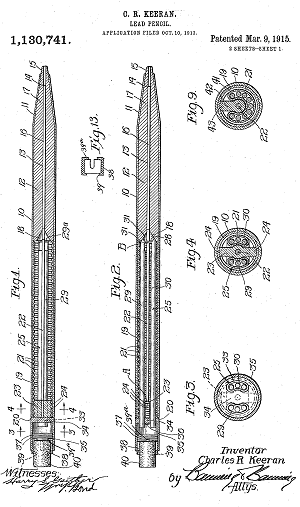
Up until recently, the answer would have seemed straightforward: Charles R. Keeran invented the Eversharp; the design must have been his. But as Jonathan Veley has pointed out, the appearance of the pencil shown in Keeran's first pencil patent is very different from our idea of an Eversharp. Instead of a metal tip, there is a wooden core, while at the other end there is an exposed eraser. Optional eraser covers are mentioned, but the designs shown in no way resemble the classic Eversharp's distinctive crown. All in all, this proto-Eversharp is most un-Eversharp in appearance. Note that no actual example of such a pencil is known, and the patent application for it was filed October 13, 1913.


The advertisement above was published in The Insurance Press of December 1912 (p. 83). By Keeran's own account, this was shortly before he first began thinking about an improved mechanical pencil. It would have been several months before his pencil patent application, and a full year before the first Eversharps were produced -- by Heath, by all evidence.


As the ad and the examples above show, Heath's clutch pencils have the Eversharp look, with the same proportions and the same distinctive crown. I had always thought that these pencils postdated Heath's involvement with Keeran. My reasoning was based upon the assumption that the Eversharp design was Keeran's, and that after Keeran and Heath parted ways, Heath must have borrowed the design for Heath's own pencils -- albeit only for pencils with a clutch mechanism, which clamped the lead, and did not mechanically push it out. Perhaps some components were left over from Heath's manufacturing work for Keeran, and perhaps some hadn't been paid for, allowing Heath to use them with a clear conscience -- or so I speculated.

The Insurance Press ad turns this all upside-down. Keeran invented the Eversharp's internals, but its "skin" was borrowed from a preexisting Heath product. We may never know exactly how Keeran's mechanism ended up being put into the Heath clutch pencil's body.  It might have been Keeran's idea; it might have been suggested by Heath while discussing how best to put Keeran's pencil into production. In any case, the resulting hybrid ended up eclipsing its progenitor. Heath likely didn't mind much, so long as it was producing both. Once Keeran switched production to Wahl it might have been a different story, but by then it was probably too late for Heath to do anything. I have not been able to find any patent for the Heath clutch pencil, either design or utility, even though one example, shown below, is marked "PAT. APP. FOR" on the barrel. This may explain why Wahl was in turn unable to prevent competitors from offering pencils that copied the Eversharp's appearance -- their number is striking, as is the closeness of resemblance.

ADDENDUM: More on the last pencil in the group of four shown in the picture above here.

Saturday, June 8, 2013

Sending an Eversharp home

Sometimes the sale is as interesting as the item. In this case, a fine silver-plated Eversharp pencil is now headed back to where it was manufactured -- as a gift to residents of the Roscoe Village Lofts, as the residential conversion of the former Wahl-Eversharp factory at 1800 Roscoe Street in Chicago is now known. The image below is from Wahl's 1928 catalog, available online through the PCA Reference Library.

Thursday, December 6, 2012

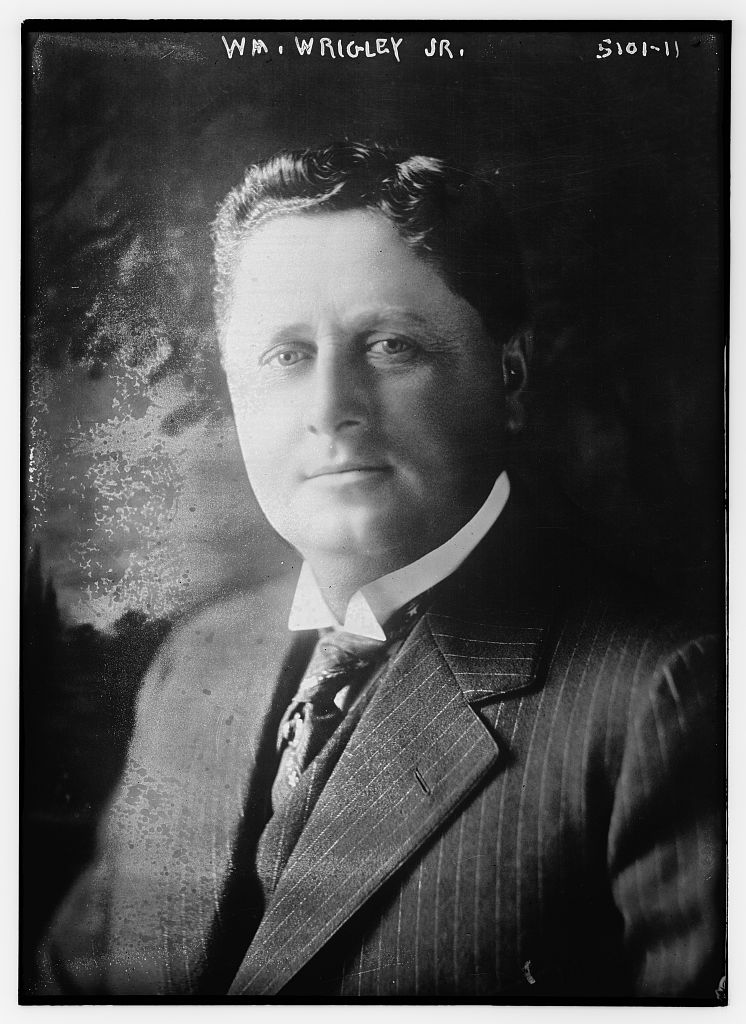
William Wrigley Jr.'s golden Wahl

This handsome little ringtop Wahl just joined our collection. It's solid 14K gold and nicely hand engraved, and it's also an eyedropper -- a design Wahl dropped from their line shortly after taking it over from the Boston Fountain Pen Company.

Even more notable, however, is the name engraved on the barrel: "Wm.Wrigley Jr./Chicago". Although the pen has no documentation of provenance, it was sold largely at gold value and there is no reason to think that the inscription was added falsely in order to enhance the pen's value.


William Wrigley Jr. (1861-1932) was a prominent figure, the founder of the Wrigley chewing gum company, owner of the Chicago Cubs, and namesake of Chicago's Wrigley Field. Wrigley was also the benevolent developer of California's Catalina Island, which he owned outright.


It was only appropriate that Wrigley owned a Chicago-made pen, and it would be interesting to find out if there were any business connections between him and the Wahl company, of the sort that have already been documented, for example, between Wahl and Montgomery Ward. The sharp-eyed may notice that the pen currently bears a Mabie Todd nib. A later replacement, to be sure, but perhaps still for the original owner. The pen itself must date to the late 'teens, and most likely was worn in a vest pocket at the end of a watch fob.

Thursday, November 29, 2012

Doric photo inlays

Every so often one runs across an Eversharp Doric with a snapshot portrait set into its cap. We sold an example from our catalog a few months back; as far as I can recall, it was the first such pen we'd ever listed.
With exemplary timing, last week we were able to acquire a 1935-dated brochure promoting these photo inlays. How long they were offered is unknown; Eversharp catalogs do not mention them, and though I have a vague recollection of some other documentation having been published long ago, they remain a bit of a mystery.

A FEW FURTHER THOUGHTS: It is interesting that the brochure makes no mention of the cost of this service, nor of how one went about getting this personalized inlay. Was it available only on special order, or could it be done to a pen already made? On Dorics, it was surely done as part of the manufacturing process, for it would have been a delicate operation indeed to mill out a recess on the back of a Doric cap, inlay the photo and its clear cover, and then reshape the cover to match exactly and seamlessly the faceting of the rest of the cap. And if done in this manner, after the passage of decades the inlay would no longer match the rest of the cap so well as is observed in surviving examples. It should also be noted that Doric facets were not cut, but mold-formed under heat and pressure, making it all the more difficult to match a cap's original profile exactly by use of a cutting tool. Unfaceted pens and pencils would have been easier to retrofit with photo inlays, yet "easier" does not mean "easy". Seamless installation of an aftermarket inlay would have required considerable skilled hand labor, surely involving removal of the clip and re-turning of the cap on a lathe.

Given all this, Eversharp photo inlays must have been special-order, installed as part of the manufacturing process. Their cost was undoubtedly insufficient compensation for all the disruption they caused to a production line set up to turn out large quantities of identical components, not individual custom pens. My guess is that the photo inlays were dropped after a very short time indeed, though I'd be happy to be proved wrong by the discovery of any other advertising for them that significantly postdates the brochure shown above.

Friday, October 5, 2012

In praise of mint pens (and of keeping them that way)

I recently had the good fortune to acquire a pristine Wahl-Eversharp ringtop set, mint and stickered, boxed with instructions. The pen is shown in the picture above. Now there are those who seem to think that leaving a pen unused is somehow sinful. Yet when one gets back to pens of the 1920s and early '30s, truly mint examples are extremely scarce, and far rarer than examples that have been used, however gently.

The greatest value of pristine pens, though, is not monetary -- in fact, compared to most other areas of collecting, the premium for perfection in pens is small -- so much as informational. Years ago, it was a pristine Wahl "Deco Band" that tipped me off to the reason why Wahl caps tended to discolor in dark bands. You can read my 2002 writeup here, the upshot being that Wahl didn't use a normal hard rubber inner cap, but instead lined the top of the inside of the cap with a soft white rubber disk, and put another soft rubber washer on the outward-facing mouth of the inner cap, where the section presses when the cap is in place. Staining and hardening over time makes these construction features, which are not mentioned in Wahl company literature, invisible. They are clearly visible on pristine pens, however -- this newly acquired ringtop included.
Another ephemeral feature that we know about only from examples such as this is the in-filling of imprints. In most cases, imprints were not originally colored in, but there are a few exceptions. One little-known exception is the gold coloring sometimes applied to the nib grade stamps on Wahl-Eversharp feeds. This gold coloring is beautifully preserved on our recent acquisition, but one can see that it would be washed away rather quickly once the pen was put to use.

The discoveries don't end there. Another recent acquisition is shown below: a coral semi-streamlined X-Seal pen, also mint and stickered. This is a rare model, and a puzzling one. The pen itself does not appear in any known catalog or advertisement, and though it shares features with other standard production models, its profile is different from any of them.
The X-Seal has been the subject of much speculation, as it appears not just on these pens, but also on regular production pens, albeit rarely. Its use follows no discernible pattern, so any scraps of information about how it was used are invaluable.
Unfortunately, the sticker on this pen is half gone. Nonetheless, it gives us some idea of the pen's original price point, and at least part of its model number. Considering how rare these pens are in any condition, to find one with sticker largely intact is no small thing.


Wednesday, May 2, 2012

Equi-Poised combination set

 Wahl-Eversharp combos are rare, and almost entirely uncatalogued. So it is especially noteworthy when an example turns up in its original box, complete with exchange pieces (which, in this case, permit reconfiguration of the set into a pocket pen and a golf pencil -- more extensive sets are known).
This set came to us from the wild, untouched and with the original (hardened) sac still in place. We've had a number of similar sets over the years, but never one so clean and so demonstrably original.