Showing posts with label ephemera. Show all posts

Tuesday, May 22, 2018

Peter Miller's reproduction pen trays

Many reproductions aren't made to deceive. Nonetheless, as time goes by and they acquire a bit of wear and age, they can end up mistaken for originals. I've noticed this beginning to happen with the pen trays originally made and sold by the late Peter Miller, an example of which is shown below.


Peter's trays were ubiquitous for a couple of decades, starting at the end of the 1980s. Nearly every pen collector owned a few. They came with either Parker or Waterman labels (nicely printed on plastic strips, the Waterman version with shiny gold letters on black), and in various configurations -- most common variations upon the basic single tray shown above being double-wide and over-under (two trays in one double-height frame). The felt color also varied, with green and red by far the most common. Since original trays were scarce and expensive, these attractive repros were understandably popular -- so much so, that they are immediately recognizable to anyone who was active in pen collecting during their heyday.


For those who aren't so familiar with the look of Peter's trays, a glance at their corners and their backs should be enough to distinguish them from originals. Their wood frames are assembled with simple mitered butt joints at the corners, whereas original trays were made with dovetail joints, as seen below.


The bottoms of the repro trays are closed up with a rectangle of stiff cardboard held in place by wooden stringers, small tacks, and a blobby application of hot glue. As these trays were never meant to deceive, no effort was made to hide their method of construction -- which is decidedly modern, and a bit slapdash. Older trays are also less than highly finished on their undersides, but even those using similar construction do not generally have the wooden stringers, and the cardboard or wood closure sheet will show more signs of age.


In addition, the labels used on the repros are printed on much thinner stock than was used for originals -- more like thick tape than plastic sheet -- with the gold of the Waterman label much more reflective than anything available in the early 20th century. In hindsight, it would have been a good idea to have stamped these on the back with the maker's name and "REPRODUCTION". At the time, though, the pen community was small and Peter's trays were so familiar that no one thought about the possibility of confusion in years to come.

PS Peter Miller's display tray and case manufacturing operation was eventually passed along to David Tallant (I can't recall the timing, but I think it was while Peter was still alive). While it is possible that these products are still being made on a small scale upon request, they have not been offered new for many years now, neither at pen shows, nor online.

Monday, May 21, 2018

Fake alert: advertising signs from India

Many pen collectors also collect pen-related material, such as point of sale displays and advertising. For the most part, the market for such material has been too small and too low-dollar to attract much interest from fakers. The exception is porcelain enamel signs, where a voracious, high-dollar market for original signs advertising automobilia, Coca Cola, etc has given rise to industrial scale manufacture of reproductions -- with the manufacturers now turning out signs with a narrower market as well, including pen signs. The most commonly seen are for Waterman, with the great majority coming out of India.


The sign above is typical, and has been offered repeatedly on eBay by Indian sellers. They usually have been banged up a bit so they don't look quite as new as they actually are. Unfortunately, eBay doesn't seem to be doing anything to crack down on what is now a veritable deluge of fake porcelain signs. You can get some indication of the magnitude of the fakery by this Pinterest post, which points out no less than 303 examples. There's also no shortage of sites and forum posts discussing the problem and proffering advice. Unfortunately, it is often difficult to identify a repro without having a genuine example for comparison. In the case of the sign above, I happen to have an example of the original that served as its model, so it is comparatively easy to see that the letters are sloppily shaped on the repro.

Wednesday, February 5, 2014

Julius Schnell and the Master Pen

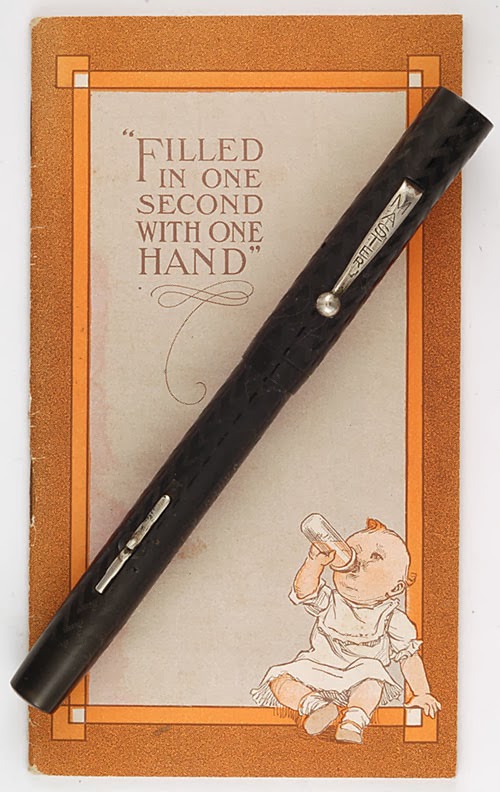
Julius Schnell is best known for his Penselpen combo of the late 1920s, but a couple of the Penselpen's patented features -- the slide-action filler and the feed -- are also found in a pen from the 'teens: the Master, by the Bankers Pen Company of New York City. The company catalog shown above is a recent acquisition, datable to 1916 by its listing of a Webster's dictionary of that date as the latest and fresh off the press.


It has long been known that Schnell manufactured parts for Bankers (see my 2001 article here), yet it was not clear if the Schnell-patented features of the Master were indicative of some closer relationship. The catalog page above leaves no doubt that Schnell sold the rights to his slide-filler outright, for a hefty $20,000. Indeed, Schnell does not appear as an officer or partner in the Bankers Pen Company in any of the sources I have consulted to date (Trow's Copartnership Directory, 1914, 1915, 1919; Directory of Directors, 1915; etc).


The patent date of June 29, 1915 appears in the imprint of the Master Special shown here; I have not seen a Master with a "PATENT PENDING" imprint, suggesting that Bankers only bought the patent (US 1144436) after it had been issued.

Another interesting statement on the same page is the claim that not a dollar had been spent on advertising by the company, "other than our circular matter" -- which helps explain why previous researchers found so little to work with. And on the facing page, where the Banker coin-filler is featured (a blog entry on an example with Schnell's 1904 patent feed is here), we find the claim that the coin-filler was "Invented by the founder of our Company and copied since, in style and appearance (but not in quality) by nearly every pen manufacturer in America", with credit given to it as being the source of the company's "remarkable growth and success." Unfortunately, the identity of the company's founder is not given, and has not been easy to track down. By all appearances, the coin-filler was never patented; according to Schnell's testimony in 1914-15, he was providing the hard rubber parts for coin-fillers to both Bankers and Salz from around 1911, and had made a prototype coin-filler for Crocker as early as 1905.

Bankers Pen may not have done any periodical advertising for its first several years, but I was able to find a few ads postdating this catalog. A Christmas ad ran in The American Contractor (vol. 37, Nov 4, 1916, p. 9, and again on Dec 2), and a few years later a big ad by the McClure Book Co. appeared in McClure's Magazine (vol. 52, May 1920, p. 74) which featured just the Master and Master Special, with the headline, "WE INVESTED $100,000 IN THE BANKERS' PEN CO.'S BUSINESS, IN ORDER TO SECURE THE MAIL ORDER RIGHTS OF THIS TRULY REMARKABLE PEN."

This would appear to be corroborated by a notice in The Bookseller, Newsdealer and Stationer (vol. 47, Dec 15, 1917, p. 870): "The Bankers Pen Company has changed its name to the Bankers Pen & Office Supply Company and the capital has been increased from $25,000 to $100,000", but confusingly there are also subsequent records of a capital reduction in January 1919, going back once again to $25,000 (Geyer's Stationer, Jan 9, 1919, p. 16; Annual Report of the Comptroller (NY), p. 469). Even more confusingly, there is a 1918 report of incorporation in Delaware: "The Bankers' Pen and Office Supply Company, of Dover, Del., have been incorporated with a capital of $250,000. They will manufacture pens and all kinds of office supplies" (American Stationer, vol. 84, Sep 14, 1918, p. 13). And then there is the notice from 1920 of a merger of "The McClure Book Co., and Bankers' Pen Co., Manhattan, with Paine's Mail Order House" (New York Times, Jan 9, 1920, p. 28, col. 2).

If the later history of Bankers Pen is muddled, its origins are equally unclear. Schnell may have been a bit off when he testified that he was supplying parts to Bankers from around 1911, as the company does not appear in the 1912 Trow's Copartnership and Corporation Directory (published each March), though it is listed in the 1914 edition. In the March 13, 1915 American Stationer (p. 11), Bankers is mentioned as "a recent incorporation", but this tells us little about how much earlier it may have been in business as an unincorporated partnership or sole proprietorship. If any readers have any further information to share, it would be welcome.

ADDENDUM: At the 2017 Chicago pen show, I was shown a Master Pen in its original box, the inside box top indicating manufacture by Salz Brothers. The discovery is discussed here.

ADDENDUM: John Jenkins was kind enough to point out a Master Pen listed on eBay in February 2024 with the imprint shown below. This would suggest production before Banker's purchase of the rights to the Master Pen. The pen itself does not show any notable differences from Banker-marked examples, noting that it has been well-used and appears to have had a number of parts replaced.

Thursday, January 2, 2014

Waterman's cigar cutter


Not long ago, online research resources allowed us to pin down the story of how Waterman's legendary Prohibition Pen came to be. And now we have written documentation of another well-known Waterman rarity: the celluloid cigar cutter, shown above. The mention is in Geyer's Stationer (vol. 58, Mar 4, 1915, p. 15), citing the Seattle Rotary Club's February 22 Weekly Bulletin:
"Rotarian Frank D. Waterman, a member of the New York Rotary Club, contributed a very useful souvenir to those present, this being a combination envelope opener, cigar cutter and fingernail cleaner."
At first glance, I wasn't entirely certain about this reference. The cigar cutter's blade doesn't seem a very effective letter opener, nor much of a manicure tool.


Fortunately, there is one surviving example that retains its original box. And there is its official description: "Envelope opener, cigar cutter, nail cleaner" -- along with the personal imprint of Frank D. Waterman himself.


The Seattle Rotary meeting report allows us to place the Waterman cigar cutter, but likely as not the cutters were also given out at other times and at other events. Frank D. Waterman was an active Rotarian who traveled extensively; although Waterman cigar cutters are now rare, this may be a reflection of a low survival rate for an item that was both fragile and utilitarian. On the other hand, the slogan found on all known examples, "The Handiest Thing in the World", was not widely used in Waterman advertising, appearing in only a few ads and only in 1915.

Kut-No-Chek, the manufacturer, made similar promotional cutters for other clients. The company is listed at 1 Madison Avenue in New York City in Polk's New York Copartnership and Corporation Directory for 1915.

Thursday, June 20, 2013

1942 Sugar Bowl pin

An ongoing project, eventually to be published in the PCA's magazine, The Pennant, has centered on a small number of early Parker 51s with smooth sterling caps and applied emblems for the 1942 Sugar Bowl. I'm not a football fan myself, but since I own one of these pens, I've picked up a few bits and pieces of related ephemera over the years. Recently I acquired a Missouri pin, complete with ribbons and attached stamped metal football. The football arrived rather squashed, probably because the pin had not been packed very well, and in straightening it out, I noticed something.
You may have to click on the detail above, but the football is clearly stamped, "JAPAN". The attack on Pearl Harbor had taken place just a bit over three weeks prior; this was probably one of the last such trinkets, at least for a good long time.

Wednesday, December 19, 2012

Some thoughts on original boxes

In many fields of collecting, an item in its original box is worth far more than one without -- so much so, that it is not uncommon for the box to be worth several times what it originally contained (a similar situation applies with modern first editions and their dust jackets). This has not been the case with pens and pencils, however, and though better boxes have come up in price a bit in recent years, even the best come nowhere near the value of their contents.

The box shown above is a rare one, only the second example I've seen. The pen that came inside is also rare: one of the earliest retracting-nib safety pens made, produced for only a few years in the mid-1890s. Since the box came up at auction, I had to give some thought to how much I would be willing to bid, which in turn got me thinking about the valuation of pen boxes in general. Why don't pen collectors value boxes so highly? Is it because so many collectors think of pens more as items to be used, than as historical artifacts to be preserved and studied? Is it because there are so many boxes available?

Certainly in comparison to many other collected items, the supply of original boxes is high. Perhaps because they were small and easily repurposed, many survive. And since cheaper pens and pencils were often sold in the same boxes as more desirable models, collectors who care about boxes usually have little trouble finding them. This has kept prices down both directly and indirectly, as general availability has shaped collectors' attitude towards what boxes should be worth. Even in those instances where the original box for a desirable pen is much rarer than the pen itself, few collectors are willing to pay more than a small fraction of the pen's value for its box.
It's hard to buck the tide. I was able to buy the Horton box for well under my maximum, yet that maximum was still a fraction of my maximum bid for the last Horton pen that came my way. I knew I was being cheap; at the same time, I was pretty certain no other collectors would be any less so. And though the box is unquestionably rare, so is the pen. No premium for rarity when the loss rate for each is comparable, I suppose.

Thursday, September 13, 2012

Quink Concentrate

At just two inches (5 cm) high, this is one of Parker's smallest Quink ink bottles. The instructions on the side of the box state:
Pour the contents of the phial into a 4-OZ. bottle and fill with CLEAN COLD WATER.
In doing this BE SURE TO RINSE out the phial several times to make certain that ALL the content is used.
Quink Concentrate was a WW2-era product, marketed in the UK. The ad below explains more, noting that "the bottle shortage is greater than ever". The need to economize on shipping was a major concern during wartime; another response to this need was "V-mail", in which letters were copied to microfilm and re-printed at the letter's destination. Unused WW2-era V-mail ink is still commonly found in the USA.


Sunday, July 8, 2012

Ghost gold pens ad

I've been doing a lot of digging into the history of the early gold pen makers of New York recently. So it was a pleasant surprise to run across this photo of an ancient and very faded painted advertisement somewhere on Nassau Street -- one of the centers of the trade in the 19th century.

I can't quite make out any of the words above "GOLD PENS", nor is there any further information in the original post (where you can view the full-sized version of the image above, along with a host of other ghost ads from times past).

PS From Google Maps, the building appears to be on the east side of Nassau Street between John and Fulton, with the photo taken from somewhere near the intersection with John Street, looking northeast down Nassau. Street View doesn't help much beyond this -- no idea of the exact address, or if the ad is still visible (the picture was posted in 2008).

Saturday, June 30, 2012

Conklin blotter

When I first got this blotter it seemed unremarkable, though the use of the old ink blot disaster trope provided some amusement. It was only at second glance that I noticed the swastikas, used to highlight the slogan, "You Never Blot with a Conklin" (you'll have to click on the picture to see the larger version). The blotter may be dated to the 'teens, when the swastika was still an innocent symbol most closely associated with American Indian art and design.

Thursday, June 7, 2012

Livermore in Providence


A. T. Cross may be the best-known early pen manufacturer in Rhode Island, but Livermore was another company making large numbers of stylographic fountain pens back in the early 1880s. The die-cut trade card shown above lists a Boston address, while other flyers place the Stylographic Pen Company in New York City; nonetheless, Livermore appears to have been based in Providence, the other addresses being those of agents and distributors.


The bronze Medal of Excellence shown above was awarded in 1879 by the American Institute to Charles W. Livermore "For Stylographic Pens". Pen companies bragged about the prize medals they had won, but surviving examples are rare indeed.

Shortly after beginning working on this post, I ran across the brief notice above. Dating from 1885, it states that Livermore's Providence factory was a four-story brick building at the corner of Arnold and Brook Streets. This really caught my eye, and after a quick look at Google Maps, it seems pretty clear that the factory site can be none other than Brassil Park -- the very same playground that my daughters go to nearly every day from their nearby school!

UPDATE: The most probable site of Livermore's factory appears not to be the park, but immediately across the street to the south. The park was occupied up until 1955 by the Arnold Street Primary School; across the street stood the Hennessey Laundry building -- a four-story brick structure.

UPDATE: ID confirmed as the Laundry Building -- according to the kind reference librarian at the Rhode Island Historical Society, the 1886 and 1887 editions of the Providence City Directory list C. W. Livermore at 44 Arnold St, in the business section under Pen and Pencil Case Manufacturers. The name section of the directory lists Charles W. Livermore, Stylographic Pen Co., at the same address. Livermore died in Warwick in 1889, and it's not clear what happened to his pen business afterwards. In the 1892 directory, 44 Arnold Street was listed as housing a "steam laundry" as well as two other businesses. I will try to get to the Historical Society library next week to see what more I can find, and perhaps to the Providence City Archives as well.

ADDENDUM: Though I did not mention it in the original post, Livermore himself had a rather interesting life. From Walter Eliot Thwing, The Livermore Family in America, 1902, pp. 658-9:
He was the general superintendent of the Spencer Repeating Rifle Works in Boston during the early '60's, perfecting the famous rifle used in the Civil War. He became an ardent worker for the eight-hour league, and for a few years was a member of the common council of Boston from Ward 11. At that time he lived on Shawmut avenue, corner of Lenox street. After the war was over he moved to New York City, and opened the first "dollar store" that became prominent on Broadway. Later on he moved to Metuchen, N.J., and introduced there the artesian drive well, of which many at the present time bear his name.

When the Lehigh Valley railroad passed through that town he sold his property, and after being elected judge of that district, and serving three years, he returned to Providence in 1871, identifying himself again with the manufacture of jewelry, under the firm name of Rathburn, Leonard & Livermore, until the death of both of his partners, when he continued the business alone for a short time. He was the first person publicly to introduce a successful fountain and stylographic pen, and that which bears his name has come to be very extensively used in this and foreign countries. He established agencies for its sale in the principal cities here and in Europe.
What isn't mentioned in this account, though, was Livermore's role while on the Boston City Council in the recovery and preservation of the wreck of the Pilgrim-era ship, the Sparrow Hawk -- a wreck whose traditional identification has recently been confirmed by an in-depth technical study. Contemporary accounts of the excavation and display of the wreck on Boston Common may be found here and here. Livermore eventually donated the Sparrow Hawk to the Pilgrim Society in Plymouth, as described in the December 1888 issue of the Proceedings of the Massachusetts Historical Society, pp. 216-19 (Livermore describing himself as "much broken in health" and "desirous of finding the most suitable permanent resting-place for it").

Saturday, June 2, 2012

Caw's trade card

The heyday of trade cards was the last couple of decades of the 19th century, so examples advertising fountain pens are rare. This one is a die-cut, but the "Caw's" seems to have been cut off!

For more on die-cut trade cards, see Burt Purmell's article here. Since this card lists the Caw's safety, it must have been printed no earlier than 1896.