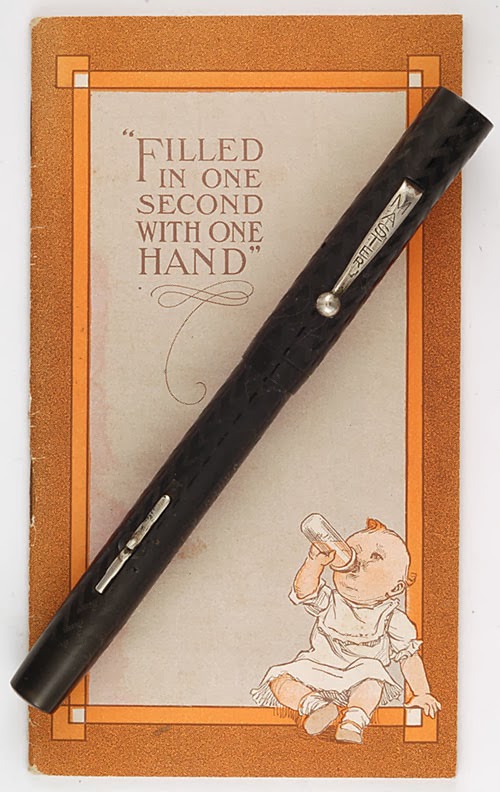
This ad is from a 1910 issue of The Bookseller & Stationer, a Canadian trade periodical. It nicely illustrates how stationery stores would contract to have fountain pens (and other products) made under their own names, and that many pen companies were happy to supply them. Most were like Sanford & Bennett in being New York based and not in the top rank when it came to market share and brand recognition.
A blog about antique and vintage writing instruments: fountain pens, mechanical (propelling) pencils, dip pens, and more.
Saturday, May 9, 2026
Wednesday, August 20, 2025
Gold fabrication notes: a 1930s Swan section overlay
Thursday, February 8, 2024
Waterman and Heath
It has long been known that Waterman purchased overlays from George W. Heath & Co. A number of early Watermans bear silver overlays with the Heath "H" mark, and though the mark is absent on later examples, the continuity of style and workmanship strongly suggests continuity of sourcing. The same pattern of marking is seen with other penmakers using Heath overlays, and it is reasonable to suppose that all eventually chose not to give their subcontractor free advertising -- especially as Heath began to manufacture and sell fountain pens under their own name around this same time. It is not known why the Heath mark only appears on the silver overlays and never on gold filled or solid gold examples, even though their common source is clearly evident.
Nearly ten years ago I wrote the following about Heath's operations from the mid-teens onwards:
While the company continued to offer items under the Heath name, by all evidence the bulk of its business lay in contract manufacturing. Quantity of surviving examples isn't always a reliable gauge of quantities produced, but in this case the contrast between the scarcity of Heath-branded pens and pencils and the size of the factory and workforce is too stark to ignore. I strongly suspect that Heath continued to be the prime supplier of high-quality overlays to the US fountain pen trade as long as overlay pens continued to be made. In particular, Heath was probably the maker of all of Waterman's overlays -- early electrodeposited fine silver examples a possible exception -- from around the turn of the century all the way to the end of overlay pen production at some point in the 1930s. Waterman often publicized its production methods, and in some detail, yet never in any of these accounts is there any mention of in-house manufacture of overlays.
This speculation about the company's later history must now be amended, as there is good evidence that Waterman was manufacturing overlays in-house by at least the beginning of the 1920s. This is found in the description of Waterman's newly completed and occupied factory in Newark, New Jersey, published in the American Stationer of March 26, 1921 on p. 11 (and subsequently republished in other periodicals, such as Pacific Ports, June 4, p. 158, and India Rubber World, August 1, 1921, p. 840). The factory was notable for both its size and the horizontal integration of operations, including ink production and the distribution of dealer display material. On the third floor was the "gold and silver mounting department" and on the second, the "chasing and ornamental mountings department" -- "mountings" being the contemporary term for what we call overlays (also used to denote trim bands, but in this context clearly referring to overlays as well). I have not been able to find any mention of such departments in earlier Waterman factories, but for now this should be taken as absence of evidence rather than evidence of absence.
What was Heath doing at this time? In my 2014 post I noted that "The later history of Heath is particularly obscure, with many of the usual online sources unavailable in volumes postdating the 'teens." Yet it was clear that the company was moving in new directions in the early 1920s:
The brothers were already diversifying . . . while they held a number of patents, the latest that has anything to do with writing instruments is US 1514965 (an extending pencil), applied for in 1922. All subsequent patents, starting with US 1605723, also applied for in 1922, are radio-related, and from the 1923 Newark city directory on, we find the Heath Radio and Electric Manufacturing Company ("radio parts and condensers") listed alongside George W. Heath & Co. at the same address.
While the (possibly older) company letterhead still proclaimed George W. Heath & Co. "Manufacturing Gold and Silversmiths" as well as "Patentees and Sole Manufacturers of Heath's "Tribune" Pencils and Fountain Pens" in a receipt dated October 26, 1923, the company had also placed a wanted ad a year before in The Iron Age seeking to buy a screw machine -- a large investment and a clear commitment to automated mass production.
In retrospect, my interest in Heath's overlay work led me to underestimate the extent of their pen and pencil manufacturing operations. It should have been clear that Heath was moving into manufacturing in a big way in the 1910s -- mass production, not artisanal hand work -- and I have recently found further corroboration of how early this started in the April 19, 1911 testimony of Hobart W. Geyer in the legal battle between Waterman and the Modern Pen Company, appealed all the way up to the US Supreme Court. On p. 1419 of the record, Geyer is asked, "Have you been in any factory during the last three years?" to which he answers, "I have been in Heath's several times in that time." "What kind of factory is it?" he is asked, to which he answers, "They make rubber holders and they make mountings." On the following day another witness, gold nib maker DeWitt C. Van Valer, also mentions Heath's factory in an exchange recorded on p. 1517. "When were you in Mr. Heath's factory?" "Within the past year." "Mr. Heath is a comparatively new man in the manufacture of rubber holders, is he not?" "I think he has been turning holders to my knowledge for the last four years, and may have been turning them before that." This lines up with the change in how Heath's business was described in directories of the time, from chasing and gold and silver novelties to fountain pens and pencils. This also lines up with the expansion of Heath's workforce and the move to a new factory in New Jersey in 1912. The demand for hand-worked gold and silver was declining, not growing: it wasn't the traditional bench jewelers leaving New York for New Jersey, but rather the manufacturing firms that required ample floor space for large machine tools and multistep production operations.
At this point we can only speculate about what happened in the 'teens and early 1920s, as Heath moved away from handwork and Waterman brought overlay manufacture in-house. I have found no record of workers moving from Heath to Waterman, let alone a formal transfer of a whole department. But skilled workers in the pen trade often moved from company to company, as is shown repeatedly in the testimonies cited above. And with Heath and Waterman's Newark factories only a little over a mile apart -- neither unionized -- continuing cooperation at some level can by no means be ruled out.
Sunday, October 22, 2023
Unpacking "made on original Parker machinery"
There is a misconception among pen collectors regarding the claim that certain aftermarket pen parts were made on original Parker machinery. While the claim might be narrowly true, the use of an ex-Parker buffing wheel or drill press isn't what is called to mind. Rather, the implication is that the aftermarket parts were made in exactly the same way as the originals and to the exact same specifications. If we are talking about plastic parts, this they were not.
These parts were machined, not molded. Parker made them using automatic screw machines, which were large and very expensive programmable analog machine tools that could be configured to produce all sorts of parts. The size and cost (even used) of such machines made them utterly impractical for a small shop, along with the difficulty and expense of setting them up. They were only suitable for large-scale mass production, and nowadays have been almost entirely replaced by digitally-controlled CNC machine tools. Even if one were to gain access to an ex-Parker screw machine, it wouldn't be any different from one that had been used to make bicycle or clock parts. The machine itself wasn't what made the parts so much as its programming.
Saturday, December 4, 2021
An unfinished Waterman nib
Unfinished nibs don't turn up that often. This one is a 1940s Waterman nib for a Taperite, which has been shaped, imprinted, and tipped, but hasn't had its slit cut or tip ground.
At first glance, it might seem that there is no tipping yet attached. The tip is visibly thicker, yet it seems to be all of the same 14K gold alloy as the rest of the nib, whether viewed from above or below. This, however, neatly illustrates how older gold nibs were often tipped -- and especially those with wider oblong tips.
Rather that welding a pellet onto the very tip of the gold nib blank, the tipping material was attached to the underside of the tip, enclosing the tipping material with molten gold. The tip was then ground, revealing and shaping the tipping material under the gold. Where the tipping would not have to be exposed to contact the writing surface, the gold was left intact, wrapping around the tipping for maximum support (a description of the process from 1912 can be found here). This is why the tipping on many older nibs is barely visible from the top of the nib -- which has sometimes led to the mistaken impression among those accustomed to modern fountain pens that the vintage tipping is worn down and not fully intact.
While the most dramatic examples of this are to found in early 20th-century stub and italic nibs from makers such as Waterman and Mabie Todd, the Sheaffer display from c. 1940 shown above also nicely illustrates another variation of the same basic procedure.
PS This is a good opportunity to point out that this method of nib manufacture can make it very challenging for a restorer to retip an older nib so that it looks 100% original -- or even to retip it at all. It's not widely appreciated that retipping that preserves an old nib's appearance requires the addition of gold to the tip before new tipping is attached (old retips were done without adding gold, leaving the retipped nib's proportions awkwardly shortened). It's also not widely appreciated that many highly flexible vintage nibs were thinned after tipping, sometimes leaving the gold of the tines so thin as to make attachment of new tipping almost impossible without burning holes in the gold.
Friday, December 6, 2019
An Eagle with filled imprint
I am not a fan of the fashion among many pen collectors of using china markers or the like to highlight imprints. In the vast majority of cases, imprints were not originally filled, and to my eye an imprint filled with bright white pigmented wax is glaring and throws off the overall aesthetic balance of a vintage pen. There are some cases in which imprints were originally filled, but typically the infill was colored rather than white.
Eagle, for example, often filled their imprints with gold pigment. The pen above nicely retains its original infilling, in a special imprint for the well-known Albany, New York company, W. H. Sample & Sons, founded in 1871 and using this business name from 1917. The company sold cutlery, leather supplies, and sporting goods; its name is especially familiar to collectors of vintage straight razors.
Although the Eagle name does not appear anywhere on the pen, "Capitol" was an Eagle trademark, registered in 1906 but in use since 1890, and both the shield imprint on the nib and the ribbed section are characteristic Eagle design features. The pen likely dates to the later 'teens.
Saturday, September 28, 2019
Anomalous Aikin Lambert fountain pen nibs
The nib at left has a very distinctive keyhole pierce, identical to those found on Parker Lucky Curve pens of the first and second decades of the 20th century. Offhand I cannot think of any other contemporary pen brand with a pierce anything like it. What does this suggest regarding where Parker was getting at least some of its nibs?
The nib in the center has an oval pierce that is also distinctive, albeit not to the same degree. While it also recalls Parker-marked nibs, similar pierces are also found on gold dip nibs from multiple makers. I have included it here nonetheless, circumstantial as its evidence may be.
The nib at right has a pierce at least as distinctive as the keyhole. Star-shaped pierces on gold nibs are virtually unique to Fairchild, with it generally accepted that the few known examples of early Waterman nibs with such pierces were Fairchild-made (Fairchild being Waterman's first documented nib supplier). So what is such a pierce doing on a nib made by a rival firm? I can only speculate that any earlier rivalry dating back to the dip pen era would have been history by the time this nib was made in the early 20th century, and that Aikin Lambert and Fairchild's nibmaking operations likely ended up converging under Waterman. We know that Waterman absorbed Aikin's nibmaking operation into their own by around 1910; so far, we know much less about the later history of Fairchild. This nib, however, suggests that by the 'teens Fairchild may no longer have been producing their own nibs -- suggesting in turn that their nibmaking operation had by then been sold to Waterman.
Thursday, July 11, 2019
Unbranded pens: a French case study
The number of companies that made pens was considerably smaller than the number of companies that sold them. Many pen retailers did no manufacturing at all, relying instead upon contract manufacture. This is neatly illustrated by the group of French safety pens from the 1920s shown above, all but four unimprinted. The imprints all differ, though the pens themselves are otherwise identical.
Only one pen in the lot retains its original warranted 18K nib. It is an unmarked pen, shown below. Who was the actual maker? I don't know -- but I do know that it will be interesting to see what pen history sleuths will be able to find out in the years ahead about all the behind-the-scenes arrangements between makers and sellers.
Wednesday, January 9, 2019
A 1947 snapshot of the German fountain pen industry
At the most recent Madrid pen show Duncan Sewell was selling reprints of a most interesting British government publication. Titled simply "German Fountain Pen Industry", this is a 29-page report published in 1947 by the British Intelligence Objectives Sub-Committee (B.I.O.S. Final Report No. 911, Item No. 35). This particular reprint is of a copy bearing the library stamp of The Institute of Mechanical Engineers, dated 20 Jan 1947, indicating publication at the very beginning of the year and compilation the year(s) previous. The report is not unknown, as there is an Open Library record for it, as well as a listing on the Books About Pens site, but as far as I can see there is no online access to digitized copies at this time.
The report is one of many that came out of the Allies' attempts to assess and manage the situation in occupied Germany. There is clear concern for getting German factories back to work, but the report openly puts Britain's interests first, both in protecting British penmakers' market share and access to raw materials, and in copying private German commercial technology for the benefit of the British pen industry. On page seven, in fact, there is a list of proprietary machine tools to be taken back to the UK for study, basically as spoils of war.
Given the constraints of time and access (the inspectors were only able to work in the British Zone, though they attempted a visit to the US Zone, which included among others Kaweco, Osmia, and Merz & Krell) the report is of limited scope and detail, but there are some noteworthy bits of information to be found. Some that I found especially interesting follow.
The inspectors found that prewar German penmaking capacity was mostly ("at least 80%") intact, but at "a complete standstill" due to lack of raw materials, celluloid in particular. In contrast to what had happened in the USA during the war, where pen factories shifted production capacity from pens and pencils to war materiel -- typically precision parts for fuses, bombsights, and the like -- the German government had largely kept its penmakers making pens:
"During the war period the industry worked to maximum capacity producing Pens as it was considered to be an essential Export, by reason of its high price; the small amount of material used and minimum amount of freightage involved.
The main Export markets were Sweden, Switzerland and The Balkans. Incidentally, if gold nibs were required, gold was supplied by the importing country."
Pen collectors have generally assumed that the withdrawal of gold nibs from the German market in 1938 meant that German penmakers stopped making gold nibs then. For export sales, however, this did not apply.
How many pens were the German penmakers turning out in this era, and prior to the war? The inspectors estimated production capacity in the British Zone to be something like twice as great as demand in the same zone. Planned output as directed by occupation authorities was to be 207,000 pens and 30,000 pencils per month, with full capacity of the industry within the British Zone at least twice that.
The report notes that most of the large firms were fully self-sufficient, while the smaller firms typically relied on specialist subcontractors in Hamburg or Pforzheim for metal parts. Celluloid tubing was identified as the main raw material used, and it was further noted that before the war the British pen industry had imported "a considerable amount" of the tubing that they used from Germany, which was also the principal exporter of celluloid to Britain. This was of particular concern, since the inspectors reported that after the war there was only one British supplier of celluloid tubing, B.X. Plastics, whose capacity was insufficient to meet British demand.
According to the inspectors, the German penmakers also made wide use of clear polystyrene tubing for ink windows, solvent-welding it to celluloid tubing as required. Rolled gold (gold filled) trim was not available at the time, only plated. The 1938 restriction on gold nibs had not been lifted, and at the time of the report still only steel was permitted.
It was recommended that a portion of German celluloid production be allocated to the UK, and that German pen export be restricted until the British pen industry had recovered. The suggestion was also put forward that export of German steel nibs to Britain be considered for use in lower-end pens, given the acute shortage of gold nibs in the UK, and that German pencil mechanisms be exported to Britain to be made into pencils for export.
One gets the impression that the report was written by men with long practical experience in the pen industry, rather than by professional administrators or academics. Capitalization is rather haphazard, and no allowance is made for foreign tastes -- though the high quality and precision of German manufacture is duly acknowledged throughout (at least for the top brands). For example, in the introduction, regarding German pens and pencils in general (p. 6):
"In the main, both Pens and Pencils are of clumsy design and inferior to United Kingdom designs"In the section on Montblanc (p. 12):
"The products of this factory, whilst being rather inferior in external design, were of high quality and workmanship. A system of floor inspection exists, and rigid tolerances in dimensions and finish appear to be the rule."And in the section on Pelikan (p. 17):
"In respect of design, the products of this factory are not up to the standard of either U.K. or U.S.A. Fountain Pens and Propelling Pencils, but the quality of workmanship and finish is of the highest order."The inspectors also tended to focus on techniques and tools that differed from British practice, and so did not bother to describe manufacturing methods shared by German and British makers -- however interesting and useful that might have been to us now. And even when methods are discussed, it is often in the briefest of terms. For example, Montblanc's method of tipping nibs was noted as being of particular interest, yet without description of that method. A little more can be gleaned from the comments on Pelikan's nib operation, where it is stated that their electric welding of nib tips closely resembled the practice at Montblanc, and entailed the use of a "simple carbon block (negative) with a flexible carbon finger to complete the circuit". But this is still far from enough to reconstruct the full operation in any detail. One tidbit that is comprehensible, if phrased in decidedly nonmodern terms, is that "much thread cutting was done by stone" at Pelikan -- which is to say, threads were cut by grinding, rather than by dies or single-point on a lathe. The inspectors also took an interest in the common German practice of black lacquering of components, especially barrels. They recorded that at Montblanc both spraying and immersion was used, with hot air to speed drying, and at Pelikan they requisitioned the formula and samples of the cellulose solution used to blacken the grip section of one-piece transparent barrels.
Of course the report noted war damage. Montblanc's factory was described as about 50,000 square feet of which 60% was usable, the rest war-damaged. Wartime production was 66% pens and pencils for export and 34% small metal screws for applications unknown to Montblanc. Pelikan's factory was recorded as having received blast damage only, and had not been used for war production -- perhaps in part because of their larger degree of automation in production and corresponding reliance upon purpose-built machines. Soennecken was described as making only steel dip pen nibs and office equipment, with no production of either fountain pens or mechanical pencils. 30% of their building was out of service from fire damage
Thursday, April 7, 2016
Unger Brothers, rebranding, and mass production in the pen trade
A cluster of Unger Brothers items recently came our way, which prompted a consultation of our reprint copies of the 1904 Unger catalog and the 1905-6 supplement. The pens don't figure very prominently, unfortunately, but the perusal was extremely rewarding for a very different reason. Though I had surely read it before, the introduction to the second reprint (Ulysses Grant Dietz, "Variety, Affordability, Modernity", The Unger Bros. Supplementary Catalogue, 1905-1906, Cincinnati, 1999) explains the company's market position in terms that are directly applicable to those manufacturing jewelers catering more specifically to the writing equipment trade. The following passage should help shape our understanding of both the marketing of generic precious metal dip pens and mechanical pencils, and that of fountain pen overlays (Heath's position, in particular):
You must keep in mind that these catalogues were not available to the general public. No consumer could possibly have sifted through the dizzying array of forms and patterns. This awesome assortment of elegant goods was aimed at the myriad retailers, large and small, who would select from it a smaller range that would be right for their particular market. A Chicago wholesaler, for example, might select a couple hundred different items that it thought it could then sell to small retail outlets in the mid- and far-west. An established local retailer, on the other hand, would select an even smaller assortment, perhaps fifty different items. These it would mix with other selections from other manufacturers, creating a product line that was unique to its own store. In this way, individual retailers created an identity of their own that was based on other manufacturers' products.
A case in point is Daniel Low & Co., established in Salem, Massachusetts in 1867 as the local jeweler-silversmith. By 1893 they had begun their own mail-order venture, and by 1901 claimed to be the largest mail-order dealers in gold and silver in the country. Their 168-page retail catalogue for that year includes silver made by many different manufacturers, including numerous pieces drawn from Unger Brothers' line. . . .Grant notes that there were over 4000 different items on offer between the 1904 catalog and the 1905-6 supplement, and that wholesale prices were strikingly low. Coincidentally, I had recently stumbled across an article in the American Stationer (vol. 36, Dec 6, 1894, p. 1038) about Unger Brothers pitching the companies' products to the stationery trade.
Consumers who bought goods from the Daniel Low catalogue probably had a vague sense that they were buying from the silversmith himself -- and that's just what Daniel Low wanted. The Unger Brothers name meant nothing to the average consumer. Only in Newark itself, where Unger maintained a retail outlet in its factory for local shoppers, did the name mean something.
There is a wrong impression among stationers that the prices of sterling silver goods are high, but we want to say that there is little difference between the the prices of the plated article and the article of genuine sterling silver. In short, we take the articles which are carried by many stationers and improve and beautify them. We mount them in a sterling finish, make them available for the finest stationers trade, and at a cost only slightly advanced over the plated article.The full passage is much longer, also mentioning Unger trying out an ad, shown below, which appears two pages previous (p. 1036).
Friday, December 18, 2015
Fine silver overlay construction
Fine silver was also used for some of Waterman's early non-filigree overlays, such as this acid-etched half-overlay shown below. The same method of construction was used, and the photo clearly shows how the surface of the silver is level with that of the hard rubber. In this case the metal is not marked as being fine silver, but it is apparent that is what it must be.
There are other construction details that can also indicate electrodeposited fine silver, even when the metal is marked "STERLING", as is often the case. This is especially common in brands other than Waterman, perhaps due to sterling being by far more recognized by the general public, then and now.
The blobby splash of silver on the rim of the cap of this Waterman is a giveaway. Surface lumps simply don't occur on sterling silver flat sheet stock (or tube stock, though this was not the norm until much later). Another giveaway on filigree pens is scoring of the hard rubber at the perimeter of the cutouts, where the workman cut a little too deeply through the soft silver. This is generally not found on overlays made from sterling sheet stock, where the cutting must have been done with the overlay mounted on a mandrel. This clearly wasn't an option when fine silver was plated directly onto the hard rubber cap.
Scoring of this sort isn't always found on fine silver filigrees, however, especially on pens where the silver layer is very thin. As noted in a 1909 article (The Metal Industry, vol. 7, no. 7 (July 1909), pp. 241-242), selective deposition was another method used, as was removal of material by either reverse plating or dissolving with acid. Although I seem to have misplaced the photo, I own a Waterman "Chased" 222 with a "STERLING" mark in relief, which could only have been done by one of these three techniques, strongly suggesting that the entire overlay is actually electrodeposited fine silver. And while the 1909 article only discusses deposition directly onto caps and barrels, there is an illustration of what appears to be a Waterman Puritan/Patch -- confirming that complex relief work was being done by deposition and not just flat surfaces.
How might this have been done? I would posit that instead of plating directly onto hard rubber, a layer of pitch would have been applied, and the relief design impressed into the pitch. The impressions would be retouched by hand as necessary, then the pitch given a conductive coating and plated. The design would be somewhat softened, in essence being molded from the back, but could be sharpened by judicious use of hand chasing. The alternative would be to plate inside a multipart female mold, which would also require some hand finishing to clean away seam lines.
Much surely remains to be discovered about the making of overlays. As a final snippet, I will add the following, which appears in the previous issue of the same journal (The Metal Industry, vol. 7, no. 6 (June 1909), p. 234):
Geo. T. Byers, 69 John street, New York, manufacturer of gold and silver chased work, has recently put in a plant for silver deposit work on fountain pens, etc.ADDENDUM: The image below illustrates how the cuts made into the hard rubber before plating could leave visible traces on the electrodeposited silver surface. These "nicks" are commonly found on thinner overlays, and are usually assumed to be the result of wear and usage rather than artifacts of original manufacturing methods.
Tuesday, May 5, 2015
Another illustration of hard rubber cap manufacture
The cap on this Wirt slip-cap eyedropper nicely illustrates how such caps were made, as discussed here and here. Before vulcanization, the soft rubber mix was wrapped in sheet form around a mandrel. The edge of the sheet is clearly visible in the top image as a longitudinal break in the patterning. The view below shows how the end of the mandrel was covered with a disk of soft black rubber mix.
Monday, April 6, 2015
OMAS selling gold nibs without tipping?
PS Looks as though this has been going on for a while. I can't believe people are buying these chopped-off nibs, let along paying a premium for them.
Thursday, April 2, 2015
More taper cap construction notes
We recently discussed the manufacture of hard rubber taper caps, and specifically how they were made by wrapping raw rubber around a steel mandrel, the rubber then being vulcanized in place. Since the unvulcanized rubber is dough-like, and not a liquid, there inevitably has to be a seam where the edges of the rolled-out rubber sheet meet. This seam is normally invisible after the cap has been vulcanized, turned or ground to final dimensions, and polished, though in some cases a telltale line of porosity can be seen -- usually on second-tier pens, where quality control apparently was not quite so strict. The seam can also become visible if the hard rubber ends up light-faded, as illustrated by the photo above (click to enlarge). In such cases, the rubber has proven more resistant to fading where it has been joined.
The first time I noticed this phenomenon was on the cap of a giant Moore safety pen in a Chicago pen show auction, long ago. At the time I could not decide if the line meandering down the side of the cap was some sort of manufacturing flaw or the traces of an extremely skilful repair. The answer only became clear years later, after seeing several other examples, reading more about how hard rubber caps were made, and finally putting all the evidence together. Once you start looking for that seam, you'll find that it's often visible but easily overlooked. This also applies to mottled hard rubber, where the seam may hide in plain sight in the material's irregular patterning.
Sunday, March 15, 2015
Taper cap construction notes
Click on the picture to see the larger version, and you'll see that the interior of the cap has an evenly textured surface. There are no machining marks, nor is it polished smooth inside. This is because the cap was made by wrapping a steel mandrel or core with a thin layer of latex "dough", which was then vulcanized, still mounted on the mandrel. When the mandrel was withdrawn, the textured surface that we see was left behind where the hard rubber had been in contact [more on other traces left by this method here]. Since a smooth finish was needed on the cap's exterior, the cap was made slightly oversize and turned down to final dimensions on a lathe.
The mouth of the cap was the other area finished in this way. The rough surface left by the mandrel would not offer an optimally precise mating surface for mounting the cap on either the section or the end of the barrel, with the roughness also being prone to leave scratches. The localized smoothing is more clearly visible in raking light.
It wasn't only taper caps that were made in this way. This was the norm for all hard rubber cap manufacture, since molding to rough shape minimized the need to remove (and waste) material. Look inside slip-on caps and in nearly every case you'll see that same characteristic roughness left behind from where the hard rubber was vulcanized on the mandrel. This is not usually visible inside screw-on caps which were machined both outside and in, for the interior dimensions and finish had to be much more precise to accommodate both the threads and the inner cap.
That texturing is also absent from newly-made replacement caps, which to date have all been made from solid hard rubber rod stock. It isn't so difficult to make other types of cap in this way, but taper caps with their thin walls and narrow tapering profile are a bit of a challenge. Most reproductions are a bit heavier and thicker-walled than an original, and if you look inside, you will often see a series of telltale steps where the interior was hollowed out by drilling using a series of progressively-sized drill bits -- a construction method never used in the past. Buyer beware, for there are a lot of newly-made replacement taper caps out there, and even experienced dealers have been taken in. There are several regular pen show sellers who have not been sufficiently forthcoming about identifying such caps, sellers who most collectors still think of as honest and trustworthy.
Friday, December 19, 2014
An unusual wartime Sheaffer
The over-the-top "military" clip is another characteristic wartime feature, allowing the pen to sit low enough in a uniform blouse pocket so as not to interfere with closure of the pocket flap. But the wartime features of this particular pen don't stop there. The section is celluloid, rather than hard rubber (rubber was a critical war material) -- not uncommon -- and so is the plunger shaft.
Wartime plunger-fillers typically used celluloid-covered carbon steel plunger shafts instead of stainless steel. These worked well enough, though the carbon steel was susceptible to rust swelling should any moisture penetrate its coating. All-celluloid shafts were another matter, as they were insufficiently rigid and prone to warpage. They are rare enough today that it is likely that they were only made experimentally -- and quickly rejected.
It would be easy enough to retrofit this pen with a postwar stainless shaft and matching blind cap (the original blind cap has a simple unthreaded hole into which the celluloid shaft press-fits), but we have put it back together as it was made, minus its original piston seal washer -- not functional as a pen, yet eloquent as witness to an era.
Sunday, September 28, 2014
Chapmans vs Waterman: Chasing machines
Q. The chasing is a simple matter, isn't it? A. It is part of the manufacturing.In later exchanges, Ferris clarified that "boys" ran the chasing machines, with "one girl in charge under a superintendent, and young men operate the machines", each "boy" running two to four machines at once, depending on the class of work. (pp. 197-98). He also stated that it typically took four to five minutes to chase a holder, depending on its size (p. 275).
Q. You simply put the pen in a machine and run it through? A. You may say the same thing of the holder, you put it in and turn it around.
Q. It takes skill to do that? A. The other requires skill.
Q. Doesn't any dollar a week girl do that? A. She does not.
Q. How much do you pay her for running the chasing machine? A. My recollection is the girl gets $12 a week.
Q. Is it run by unskilled labor? A. Experienced labor; it takes a lot of experience to operate them properly.
Q. Do they not put half a dozen holders into a machine and simply run it through a little machine and it comes out chased; is that right? A. Yes; but the machine has to be properly adjusted and operated or they don't come out chased.
Ferris's was not the only testimony about Waterman's chasing methods. A Brooklyn stationer, Van Brunt Tandy, owner of the stationery firm formerly known as John M. Bulwinkle -- reputedly Waterman's first commercial account -- was queried about his visits to the Waterman factory (pp. 238-39):
Q. Did you see anybody chasing penholders at the L. E. Waterman & Company shop? A. Yes.
Q. How is it done? A. It is done with six holders put in at a time, six caps in one section and six holders in. another section, in which a tool goes around like that and cuts them; possibly the steel escapes the part where there is any plain spaces.
Q. The result is that with all this chasing, a plain holder has this wavy appearance? A. Yes.
Q. Does one boy manipulate a number of machines? A. Manipulates two machines, one for the holders and one for the caps and one for the body. . .
Q. What did you see? A. I saw him put six caps in one machine to the left and six holders in another machine to the right, and those two machines were both working at the same time.
Q. With respect to the rapidity of the number that are produced in that way? A. I would say it would take about ten minutes to do six complete.I've been working on a full article on the history of hard rubber chasing and chasing machines, and sources are remarkably few. The material above is a useful addition to what we know of how these machines were actually used in a production environment. For further description and illustrations of the machines used by Waterman in this era, see the article on Waterman pen manufacture in Machinery, vol. 18 (Dec 1911), p. 253.
Q. A little over a minute apiece? A. They had six at a time.
Q. Do you mean to say it takes ten minutes to go through that machine? A. I certainly do. '
Q. Isn’t it done in ten seconds? A. No, sir.
Chapmans vs Waterman: A pen history trove
What I intend to do instead, is to highlight some of the tangential information brought out in the testimony. This will take the form of multiple posts, so as to maintain a degree of organization by topic. Much of the new information has to do with Waterman, but covering everything from specific designs and models to manufacturing techniques to operational procedures in the repair departments -- plus the odd intriguing anecdote. The post topics are: Ferris' testimony; Safety pen patents; Notable pens; Chasing machines; and Miscellaneous.
Saturday, March 22, 2014
George W. Heath & Co.
The mark below is not restricted to silver objects, but I have never seen it applied to a fountain pen overlay. It seems most common on gold filled pencils.
This post will concentrate on Heath's earlier history. A good starting point is a rather boosterish volume published in 1912, Newark, the City of Industry. On page 116 we find the picture above, and the following entry:
IN the year 1892, George W. and Alfred C. Heath began business as partners in New York as "chasers and designers to the trade." The original location was at 137 Elm street, New York, but owing to increasing business more commodious quarters were obtained at 27 Thames street, and later at 380, 382 and 384 Canal street.This outline history is consistent with the other records I have consulted. In the Twelfth Annual Report of the Factory Inspector of the State of New York, submitted Jan 24, 1898, p. 260, "Heath Bros." is listed as engaged in "Silver chasing", with 5 employees. The following year's report (p. 272) is the same, but with 4 employees. The report for the year following, 1899 (p. 313) is shown below (the space between the Heaths' listing and the header has been trimmed for ready reference).
In May, 1912, desiring to avail themselves of the splendid manufacturing facilities afforded by Newark, and being disposed to do their share in making Newark famous, and proving that "Newark Knows How," the firm of George W. Heath & Co. moved the office and factory to the modern fireproof structure which they had erected at 206, 208, 210 First street.
The company is engaged in the manufacture of fountain pens, and in these days of universal education when everybody can write, there is an ever increasing demand for its product.
The pens made by this concern are known as Heath's Tribune Fountain Pens, the component parts of which are made of the best material obtainable, and are carefully assembled and adjusted by skilled men under the direct supervision of the members of the firm.
Besides fountain pens the company also manufactures gold pens, gold and silver pencils and art metal goods which are sold all over the world, through agencies established by correspondents and frequent visits of traveling salesmen among the dealers in various foreign countries.
All products that are made by this company bear the imprint "Made in Newark," and the goods are worthy of the city in which they were made.
Wednesday, February 5, 2014
Julius Schnell and the Master Pen
It has long been known that Schnell manufactured parts for Bankers (see my 2001 article here), yet it was not clear if the Schnell-patented features of the Master were indicative of some closer relationship. The catalog page above leaves no doubt that Schnell sold the rights to his slide-filler outright, for a hefty $20,000. Indeed, Schnell does not appear as an officer or partner in the Bankers Pen Company in any of the sources I have consulted to date (Trow's Copartnership Directory, 1914, 1915, 1919; Directory of Directors, 1915; etc).
The patent date of June 29, 1915 appears in the imprint of the Master Special shown here; I have not seen a Master with a "PATENT PENDING" imprint, suggesting that Bankers only bought the patent (US 1144436) after it had been issued.
Another interesting statement on the same page is the claim that not a dollar had been spent on advertising by the company, "other than our circular matter" -- which helps explain why previous researchers found so little to work with. And on the facing page, where the Banker coin-filler is featured (a blog entry on an example with Schnell's 1904 patent feed is here), we find the claim that the coin-filler was "Invented by the founder of our Company and copied since, in style and appearance (but not in quality) by nearly every pen manufacturer in America", with credit given to it as being the source of the company's "remarkable growth and success." Unfortunately, the identity of the company's founder is not given, and has not been easy to track down. By all appearances, the coin-filler was never patented; according to Schnell's testimony in 1914-15, he was providing the hard rubber parts for coin-fillers to both Bankers and Salz from around 1911, and had made a prototype coin-filler for Crocker as early as 1905.
Bankers Pen may not have done any periodical advertising for its first several years, but I was able to find a few ads postdating this catalog. A Christmas ad ran in The American Contractor (vol. 37, Nov 4, 1916, p. 9, and again on Dec 2), and a few years later a big ad by the McClure Book Co. appeared in McClure's Magazine (vol. 52, May 1920, p. 74) which featured just the Master and Master Special, with the headline, "WE INVESTED $100,000 IN THE BANKERS' PEN CO.'S BUSINESS, IN ORDER TO SECURE THE MAIL ORDER RIGHTS OF THIS TRULY REMARKABLE PEN."
This would appear to be corroborated by a notice in The Bookseller, Newsdealer and Stationer (vol. 47, Dec 15, 1917, p. 870): "The Bankers Pen Company has changed its name to the Bankers Pen & Office Supply Company and the capital has been increased from $25,000 to $100,000", but confusingly there are also subsequent records of a capital reduction in January 1919, going back once again to $25,000 (Geyer's Stationer, Jan 9, 1919, p. 16; Annual Report of the Comptroller (NY), p. 469). Even more confusingly, there is a 1918 report of incorporation in Delaware: "The Bankers' Pen and Office Supply Company, of Dover, Del., have been incorporated with a capital of $250,000. They will manufacture pens and all kinds of office supplies" (American Stationer, vol. 84, Sep 14, 1918, p. 13). And then there is the notice from 1920 of a merger of "The McClure Book Co., and Bankers' Pen Co., Manhattan, with Paine's Mail Order House" (New York Times, Jan 9, 1920, p. 28, col. 2).
If the later history of Bankers Pen is muddled, its origins are equally unclear. Schnell may have been a bit off when he testified that he was supplying parts to Bankers from around 1911, as the company does not appear in the 1912 Trow's Copartnership and Corporation Directory (published each March), though it is listed in the 1914 edition. In the March 13, 1915 American Stationer (p. 11), Bankers is mentioned as "a recent incorporation", but this tells us little about how much earlier it may have been in business as an unincorporated partnership or sole proprietorship. If any readers have any further information to share, it would be welcome.
ADDENDUM: At the 2017 Chicago pen show, I was shown a Master Pen in its original box, the inside box top indicating manufacture by Salz Brothers. The discovery is discussed here.