The pen community is small and congenial, and up until now the desire to keep the peace has prevented most such confrontations. Yet given that sellers have been given ample notice (though it may be that many never bother reading or otherwise participating in the groups in which they hawk their wares) such an intervention is long overdue. As long as sellers are allowed to brazenly mislead buyers about the capabilities of vintage nibs without being publicly challenged, the destruction of old nibs will continue.
A blog about antique and vintage writing instruments: fountain pens, mechanical (propelling) pencils, dip pens, and more.
Monday, March 18, 2024
More on the overflexing of vintage nibs
The pen community is small and congenial, and up until now the desire to keep the peace has prevented most such confrontations. Yet given that sellers have been given ample notice (though it may be that many never bother reading or otherwise participating in the groups in which they hawk their wares) such an intervention is long overdue. As long as sellers are allowed to brazenly mislead buyers about the capabilities of vintage nibs without being publicly challenged, the destruction of old nibs will continue.
Tuesday, January 16, 2024
Please stop calling them "Continental safeties"
Once upon a time and long long ago, American collectors would occasionally come across safety pens with fancy overlays like the one shown above. They knew that these pens were European but not much more, so borrowing a usage from the antiques trade they started to call them "Continental" -- the umbrella term for furniture that was neither American nor British, but from somewhere in continental Europe. You don't see antiques called "continental" as much nowadays; the trade is more sophisticated and less insular, greatly reducing the need for catchall categories of this sort ("oriental" or "Asian" is another, much less used now with increased ability to differentiate between antiques from China, Japan, Korea, etc). And yet "continental" persists among pen collectors, even though English-speaking collectors have known for at least thirty years now that these fancy overlays are distinctively Italian and not generically European at all. This may largely be force of habit among older collectors, with the continuing influence of classic reference books a factor as well.
Let us finally retire "Continental" -- it is misleading and obsolete. Let us give credit where credit is due and call these pens what they are, which is Italian. No other country had so many independent workshops making such a variety of overlays, nor can the characteristic style and elaboration of these Italian overlays be mistaken for the product of any other European country. Not that French and German overlays aren't also distinct in design and style -- which is all the more reason not to lump them all together under the same catchall name.
Sunday, November 7, 2021
Grading vintage pens: why isn't there a standardized system?
"I'm rather dubious about the whole idea. The problem is that pens cannot be graded along a single scale. Unlike coins, which through normal circulation wear in a consistent manner, pens do not age consistently. One example might have extensive brassing but fine color, which another might have excellent trim but mediocre color. A single grade is insufficient description."
"What doesn't get mentioned when coins and cards are brought up is that the items graded then have to be slabbed. Otherwise there's no way of knowing if the assigned grade goes with the proffered specimen. No one is going to want pens (or pencils) that are permanently locked into a lucite block and cannot be handled."
"In any case, it is folly to think that any grading system could get any acceptance at all if introduced by someone with no knowledge of the field and completely unknown to it."
"I used to collect coins extensively, and at the time there were three different major grading companies that all might give different results. It was common for people who didn't like the grade they got to break them out of the slab and either resubmit them or send them to a different company to grade shop. I think we're just fine with what we have with pens."
"The bigger issue, frankly, is widespread overgrading. I'd love to see something done about that, both as a collector and as a conscientious seller. It's maddening to see the virtually unanimous praise in online groups and forums for sellers who are notorious for representing overpolished and obviously reblackened pens as pristine, but that seems to be the social dynamic -- where almost no one is willing to say anything bad about another group member, and where those who do speak out are excoriated and dismissed as bitter haters."
"The polishing and reblacking thing drives me absolutely insane. And that's even ignoring the claims some people make about their reblacking solution and polishes"
"Yes, anyone who tries to say "hold on, wait a minute" is trampled, and anyone without any backchannel access gets a completely distorted picture of what is what."
"This might be well-intentioned, but it's dead before it leaves the starting gate. Only a multidimensional characterization can provide the information needed to consider the condition (and, in turn, to feed into a calculation about the value) of a vintage fountain pen."
"I know there is a longing for a single grade, because it's so neat and lends itself to direct comparisons, sorting, etc. But it's misguided and wrongheaded. No collector of even modest education in the field would ever be satisfied with a single letter or number when desiring to know the condition of a pen. Never, ever."
"Having been involved in the discussion for 20+ years I think the best we can do is as complete a description as possible. There are so many variables that would go into grading you could call a pen average and a description could support that. Another pen could be exceptional but, the description would support that. Without the detailed description the grade would be useless. So a grading system is meaningless leaving one with as complete a description as possible."
"I think another factor with pens specifically is that the grade can and does change over time. Particularly with delicate plastics, the condition can change drastically over a couple of years. That doesn't happen in the same way with coins, for example"
Thursday, June 7, 2018
Yet another eBay scam
Tuesday, May 22, 2018
Peter Miller's reproduction pen trays
Peter's trays were ubiquitous for a couple of decades, starting at the end of the 1980s. Nearly every pen collector owned a few. They came with either Parker or Waterman labels (nicely printed on plastic strips, the Waterman version with shiny gold letters on black), and in various configurations -- most common variations upon the basic single tray shown above being double-wide and over-under (two trays in one double-height frame). The felt color also varied, with green and red by far the most common. Since original trays were scarce and expensive, these attractive repros were understandably popular -- so much so, that they are immediately recognizable to anyone who was active in pen collecting during their heyday.
The bottoms of the repro trays are closed up with a rectangle of stiff cardboard held in place by wooden stringers, small tacks, and a blobby application of hot glue. As these trays were never meant to deceive, no effort was made to hide their method of construction -- which is decidedly modern, and a bit slapdash. Older trays are also less than highly finished on their undersides, but even those using similar construction do not generally have the wooden stringers, and the cardboard or wood closure sheet will show more signs of age.
Monday, May 21, 2018
Fake alert: advertising signs from India
The sign above is typical, and has been offered repeatedly on eBay by Indian sellers. They usually have been banged up a bit so they don't look quite as new as they actually are. Unfortunately, eBay doesn't seem to be doing anything to crack down on what is now a veritable deluge of fake porcelain signs. You can get some indication of the magnitude of the fakery by this Pinterest post, which points out no less than 303 examples. There's also no shortage of sites and forum posts discussing the problem and proffering advice. Unfortunately, it is often difficult to identify a repro without having a genuine example for comparison. In the case of the sign above, I happen to have an example of the original that served as its model, so it is comparatively easy to see that the letters are sloppily shaped on the repro.
Saturday, May 19, 2018
Fake vintage pens on eBay
One of the most prolific and brazen purveyors of fake and misrepresented pens is the seller known as thisol*house, operating out of a Post Office Box address in Randleman, North Carolina. While some of his pens seem OK, buyers have reported overgrading and failure to disclose damage, and his standard description claims that his pens come from his own private collection -- even though many over the years have been seen to have been purchased by him on eBay just weeks before. The real problem pens from this seller, however, tend to be early (or early-style) pens with fancy metal or pearl-slab overlays, such as this "Holland":
The pearl barrel is unlike anything ever seen on any vintage pen, and is surely taken from another sort of object -- most likely a parasol handle or lorgnette holder. The bulbous metal end piece on the cap is also unlike anything genuine, and likewise has been harvested from some other item. The nib is genuine John Holland, but that's a part that costs relatively little. Without handling the pen in person I cannot tell if the cap and barrel parts are old and repurposed or newly made. Others who have bought similar pens from this seller, however, have reported that at least some parts have been fabricated out of modern black plastic, and so poorly that the cap does not fit the barrel without wobbling. Some of his pens have also had sections of a form never seen on any genuine vintage pen, sections which can safely be assumed to have been newly made.
Another misrepresented pen is this so-called "Aikin Lambert":
Once again there is an anomalous end piece on the cap -- I suspect used to cover the end so that the cap can be made out of tube stock, rather than bored out from a solid rod. It's awfully shiny for a genuine hard rubber cap. The barrel may be mostly genuine, but it most certainly isn't Aikin Lambert production. The slabs are wide and sloppily fitted, a giveaway that the pen was a contemporary economy knockoff, of the sort discussed here, still widely available for very little money. Take such a pen, replace its original nib with a name-brand nib, and offer it to the inexperienced as a name-brand pen: that's a bit of dishonesty that unscrupulous sellers have been engaged in for years.
Currently listed on eBay is the glass-nibbed cheapie shown above, "enhanced" with a Montblanc-style star in the cap top and fake Montblanc imprints on cap and barrel. German Montblanc experts are scoffing at this listing, but unsuspecting collectors are bidding on it nonetheless.
The same seller has other so-called "Montblancs" that are equally fake. Bulgaria has been the source for many of these counterfeits, but they have been sold for long enough now that examples routinely turn up in Germany and elsewhere. Note that this seller currently still has 100% positive feedback, and remains active despite multiple complaints from leading German pen experts to eBay (plus at least one message directly to the seller, who can now surely be assumed to be knowing exactly what he is doing).
A further caution: if an eBay seller insists on payment by bank transfer rather than Paypal, you'll have no recourse if you get stuck with a fake, or with nothing at all. Back before Paypal offered buyer protection guarantees, I used to use escrow.com for large purchases when I didn't know the seller. It's still a good option -- and if the seller insists on a bank transfer and won't consent to use it, that's a pretty good indication that you should walk away from the deal.
UPDATE: thisol*house left a comment on this post on May 19, 2018 at 9:49 PM, which he has since deleted -- for good reason, I'd say, which is why I kept a copy. Here it is, verbatim:
Hello David. I hope this find you well. I sell vintage pens on ebay under the ID: thisol*house. Question: Would you rather... have a fancy, restored, classic Corvette that looks like a show car and roars like a tiger... or an all original classic Corvette that just sits in the garage and can't drive anything around except your pathetic ego? While I understand that there are some who advocate for leaving a pen all original, some who, strangely, actually appreciate 125 years of oxidation and gunk buildup on an otherwise useless object (and you people are weird), surprisingly, there are actually quite a few folk who enjoy their pens being Beautiful and, get this, FUNCTIONAL! Your blog makes some incorrect assumptions and conclusions that I would like to clear up for those interested. Every pen I sell is clearly stated as restored; having been disassembled, cleaned, polished, reassembled, re-polished, serviced, tested and presented (with excellent details and photographs) ready for your favorite ink! I have the excellent feedback that I do because my pens are FABULOUS writing instruments. YES, hard rubber CAN be polished to a mirror shine, with effort, care and love for the instrument (and proper surface preparation, namely 2500 grit sandpaper). Calling a refurbished pen a "fake" is like saying..."that looks like a Mustang, but Ford never used that color, so it must be a fake car." Changing a gold band or damaged nib section, or removing and replacing missing/damaged/cracked pearl panels, does NOT make a pen "fake". And by the way, John Holland nibs do NOT cost "relatively little." These fantastic 140 year old noodle nibs are almost impossible to find with good tipping, then the tipping must be smoothed, then the nib polished and properly mounted with an adequate vintage feed. Several COMPETING EBAY SELLERS have attacked the credibility of my pen business. Instead, maybe they should extend their efforts to examining my business model to try to improve their own businesses. I have 4320 feedback, 100% positive feedback (not counting one neg from competitive pen seller Susan Bowen from Texas, who REFUSED to return the $555 John Holland pearl pen, because it was BEAUTIFUL and wrote like a DREAM!). I offer a 100% Buyer Satisfaction Guarantee on EVERY pen I sell, which I ALWAYS stand behind, but is very rarely needed. Returns are ALWAYS accepted. I don't even ask for a reason. I even pay return shipping. AND, I produce professionally restored, vintage pens that make handwriting once again a JOY! Yes, maybe the competition could try a little customer service and caring for their customers needs... encouraging new collectors instead of berating them for asking how to fill a cartridge pen. Pen folk were once a noble breed, but like everything else, the world is changing. I have enjoyed the thousands of hours spent restoring my pens over the years, and YES, if they went across my workbench two weeks ago or two decades ago, they ARE from my personal collection! Yes... 40 years, and they're almost all gone now... and I have no reservations in saving... I'm glad I sold my collection.Incidentally, the mention of Susan Bowen actually refers to Glen Bowen, veteran collector, author, and founder of Pen World magazine. Glen bought one of thisol*house's fakes to get a hands-on look, and to see exactly what it was and how it was put together.
UPDATE, 29 Dec 2018: The thisol*house account has been quiet for several months now, but the same seller is still very much active on eBay under his secondary username, dowrite2. Most of the pens on offer recently appear genuine; we have not seen any of the complete fakes for some months, though there is the occasional deliberately misleading listing for a flashy but cheaply-made no-name dropper-filler with a name-brand nib stuck in the front -- this "Laughlin" being a recent example. In this case the seller was careful to describe it as a "Laughlin pen" only in the main photo, and not in the title or the text of the description, where it is referred to as an eyedropper with a Laughlin nib.
UPDATE, 10 Jan 2020: He's back and up to his old tricks once again -- though he seems to be taking more care to make his descriptions simply misleading rather than brazenly false. An example is this "Vintage 1890's EYEDROPPER Fountain Pen", which is not explicitly described as a Grieshaber in the listing text, though the attribution is implied in the writing sample.
Apparently this pen was returned, as it was originally sold for a whopping $650 on 22 Dec 2019 -- a very nice return for popping a Grieshaber nib into a no-name cheapie overlay. Note that it would appear that the nib was originally a ventless dip nib, and that the round vent hole was added (I'm not a Grieshaber specialist myself, but that's what the experts's consensus seems to be).
Wednesday, July 5, 2017
1942 time capsule
These items all came from an Oakland, California shop owned by Japanese-Americans who were interned shortly after America's entry into WW2. The family did not reopen the shop after the war. These leftover items remained in storage for some 75 years before being offered to us. Opening the package was a moving experience; some items were packed with bits of contemporary newspaper, and two letters from Waterman to their dealers were dated only shortly before Pearl Harbor turned everything upside-down. A good number of the items in the group were contemporary Watermans, stickered and mostly boxed. There were also a few older pens, including a few Waterman overlays and a couple of solid gold Conklins from the 1920s or early 1930s -- expensive and for most retailers, slow sellers. Most notable, however, was the large number of colorful Japanese-made celluloid Pilots, unusual enough but doubly so as export models with English-language labels, boxes, and instruction sheets. Cheap Japanese novelty pens were widely imported in the prewar era, most notably the now-ubiquitous stubby jumbos and glass-nibbed SPORS crescent-fillers. Better-quality prewar Japanese pens were another story, and any found in the wild in the USA were likely acquired by soldiers as war trophies or purchased during the postwar occupation. This hoard represents an exceptional case, with Japanese goods that would have found little interest outside of the Japanese-American community. In fact, the Pilots were far from cheap, with the prices penciled on the bottoms of the boxes running from $3.50 to $7 -- in the same range as the contemporary Watermans, which were mostly priced around $3, with a large Hundred Year priced at $8 (with the Watermans decidedly better made).
Some of the Pilots are conventional lever-fillers, but most are either plunger-fillers (US patent 2070461) or the distinctive nomikomi-shiki (呑込式) "easy-drink filler". The nomikomi-shiki pens have a special long-tailed feed and internal celluloid reservoir. They are filled using a special bottle with a central opening into which the pen can be inserted nib-first, sealing around the section. Bottle and pen are then inverted together, allowing ink to flow through the feed and into the pen's reservoir. Since the latter design was only patented in the US on January 17, 1939 (patent 2144296), the mention of the US patent in the instruction sheets helps narrow down the date of these particular examples.
Factory-new nomikomi-shiki pens must be exceedingly rare, so I made sure to make notes when taking one apart. The celluloid barrel is a slip fit over the section, not at all tight, but instead held by a thick, tacky transparent compound. The same substance holds and seals the clear celluloid reservoir housed inside the barrel. The reservoir is made of very thin material, and though it is threaded to match the threads on the section nipple, it is so loose that it can be pulled straight off, resistance coming almost entirely from the sealing compound. Using plain cold water on a cotton swab, I cleaned off the compound from the inside of the reservoir, only to find that exposure to water was enough to cause the material to open a crack along its longitudinal seam. Clearly, these pens should be preserved as relics, as they are emphatically not users! I did carefully measure the reservoirs, though, as it would be very easy to make new ones out of sturdier modern plastic.
I have been promised more information about the store and the family that ran it. When that comes, I am looking forward to publishing a much more extensive and comprehensive article about these pens and their singular history.
Monday, September 5, 2016
Pen show frictions, Part 4: users vs collectors
The great majority of collectors, whether their focus is vintage or modern, use at least some of their pens. Many users also collect to some degree or another. Yet despite the considerable degree of overlap, there are fundamental differences, with each group most strongly interested in things that are of very limited to no interest to the other. This divergence of priorities inevitably leads to tensions, since fully accommodating both groups at the same time isn't always possible.
At pen shows, for example, most vintage sellers group their pens by brand and model, to cater to collectors, rather than by nib type, to cater to users. A request for a specific nib type may not be received with enthusiasm by a seller whose pens are not organized accordingly -- not out of any animus towards users at large, but rather out of irritation at being personally inconvenienced. It's a bit like going to a farm stand, and instead of asking for three apples or a pound of green beans, asking for five different items of produce between four and five inches long and red. The first few times, such a request would likely be met with amused surprise -- but it would not be long before both the surprise and the amusement would wear off.
At least at the farm stand doing the selection oneself is an easy out; at a pen show, it entails opening up and examining every single pen on a table -- inefficient, inconvenient, and disruptive. Add in the time and space required to dip-test any suitable candidates, and the seller's total combined hassle factor for serving the average user ends up dwarfing that for the average collector. Sellers set up to deal with collectors are even less favorably disposed when the average user doesn't spend as much as the average collector, and after going through all of the above, often doesn't buy anything at all.
Note that this situation arises entirely innocently, rooted as it is in a fundamental mismatch between what the buyer is seeking and what the seller is set up to provide (paralleling another mismatch outlined in our Part 1: retailer shoppers vs traders). And there has already been a degree of bridging of this divide, for as some users have shown their willingness to pay as much or more than collectors, collector-oriented sellers have become more user-accommodating. This trend has been visible online for some time now, but has been slower to be felt at shows -- not surprising, given the practical impossibility of making a table full of pens keyword-searchable. Nonetheless, it is now common for sellers to add color-coded nib grade labels or to put out a tray specifically devoted to pens with flexible and italic nibs, even if their main focus remains the collector market.
This goes way back. Years before the current crop of bloggers took up their pens, anti-collector sentiment was already bubbling away in online forums. And though it may not be so apparent now, at least some of the nastiness was fueled by a form of the ancient delusion that when prices are high, it is the storekeepers who are to blame. With blind disregard for the realities of supply and demand, dealers and collectors were scapegoated, blamed for running up pen prices on eBay and sucking up all the affordable pens from antique shows and shops. Collectors were accused of not really loving pens, of being soulless hoarders, violators of the moral imperative that every pen must be put to use and not enjoyed in any other manner. And if the accusations are no longer repeated quite so often and so openly, the underlying sentiments live on, as in the ongoing use of the expression, "the 'C' word", which jokingly-but-not-really makes "collector" out to be an epithet too vile to be uttered aloud.
Sunday, September 4, 2016
eBay and the Great Disintermediation
While there was some online trading before the advent of eBay, the volume was tiny and restricted to a small subset of already-active pen traders. It was an insignificant sideshow, as nearly all trading took place face-to-face: at shows, club meetings, flea markets, live auctions, and antiques fairs. In the USA, there was relatively little retailing of collectible vintage pens. There were not many buyers willing to pay much over pen show prices, and it was not easy to reach them -- even for sellers with bricks and mortar shopfronts.
The flow of vintage pens through the market prior to eBay was a long and inefficient one. An old pen would typically enter the market at a yard sale or flea market after being found in a desk drawer or long-shuttered shop. Bought by a picker, it would then be flipped quickly for a small profit to a local general antiques dealer, who might sell it on to another dealer who knew a little more about pens, or who had a pen buyer as a customer. In this extended food chain, a pen could easily go through several hands before finally being sold at full value to an end buyer. At any point, of course, the passage of a pen could be interrupted by being bought and kept by a buyer paying less than full value, who might well have been outbid had more committed buyers been in on the action. Nor did an end buyer have to buy from a specialist dealer, as there was nothing preventing anyone from hunting lower (and more cheaply) on the food chain -- the tradeoff being that as one went lower, so did the ratio of desirable items to chaff.
eBay's impact was not felt immediately. With only a relatively small number of participants at first, and lacking the search and bidding tools we now take for granted, eBay could turn up nice finds for buyers with knowledge and persistence. Overall volume was still too low, however, for eBay to be more than a minor supplement to pen buyers' traditional sources of supply. This began to change once new buyers -- many from overseas -- who had never been exposed to the existing collector market started to bid up ordinary pens to extraordinary prices. This bidding seemed to be based on a combination of excitement over never-before-seen (by the newcomers, that is) items and the auction version of the Greater Fool principle -- that is, the assumption that one can't go too far wrong if someone else is bidding just as much. By the end of 1998 several boxed Peter Pans had sold for $500-600 each; other pens that were common but of unusual form or design also fetched similar sums. It wasn't just pens: small ladies' watches that dealers hadn't been able to give away suddenly were being bought for hundreds of dollars, for example.
Prices like these quickly attracted a horde of new eBay sellers, and prices settled down as supply moved online to meet demand. Offline, meanwhile, things were changing quickly. The old antiques food chain was coming apart, as those at the bottom started selling directly to those at the top. So did everyone in the middle, even as they began to lose their sources lower down the chain. Thus began the Great Disintermediation, as the middlemen found themselves increasingly cut out of the flow of merchandise through the market. Most saw that things were changing, but couldn't grasp that the changes would be so dramatic and so fundamental. The following years saw the dwindling or disappearance of a host of long-established places and events whose main purpose had been to facilitate dealer-to-dealer transactions, including group shops, wholesale antiques shows, and live auctions. Collector-to-collector events were similarly affected: the New Jersey show was sold by its original organizers around this time for a price in the low five figures, only to be unsuccessfully put up for sale (on eBay!) only a few years later, and eventually liquidated for a nominal sum for the value of its mailing list.
As the middlemen were cut out, the market was flooded with material. It was as if a pipeline had suddenly been drastically shortened, pushing its excess contents out all at once. Since most of this content came from nonspecialist dealers who had always sold lower down the food chain, it ended up on eBay with low or no reserve. This didn't have much effect at the low end, for the cheaper vintage pens hadn't far to fall, were already in plentiful supply, and had no shortage of buyers, but the market for midrange and high-end pens was another story. It didn't help that many older collectors were slowing down at this point, just as the newer online collectors were still working their way up from lower-end models. It took years for the midrange to recover, while the high end still isn't where it was pre-eBay. The problem largely was (and remains) one of market confidence: at the high end, the number of buyers was never large, dealers included; when combined with the retirement of older collectors and a weak global economy, this sector of the market was easily flooded. All it took was a few examples of a rare pen to hit the market in quick succession (a statistical inevitability) for prices to tumble. Since these transactions were now taking place in full sight of the world, the effect on market perceptions was powerful and lasting, even in cases where no more examples appeared for years afterwards. Not infrequently the reason a selling price was low was because potential buyers failed to spot the item, or because dealers agreed to buy it in partnership rather than compete -- not to mention cases of bid failure, issues with condition or authenticity, etc -- but for those not in the know, it all looked the same.
This is still very much the case. Where trading is thin, the post-eBay market remains more vulnerable than the pre-eBay market to inconsistent sales results and a resulting loss of confidence. There is a pervasive assumption that online auctions are true indicators of value, though they are subject to many of the same inefficiencies as other sales. And where dealers once played a significant role in buffering the impact of short-term fluctuations in supply and demand, the experience of the last fifteen years has left dealers less willing to buy and hold as they once did. Where there is inconsistency, however, there is also opportunity -- but that is a topic for another post.
eBay's shortening of the collecting food chain has had other effects, too. Some items appeal to multiple groups: original counter-top pen displays, for example, are also sought after by advertising collectors; pen-related trade cards, by collectors of ephemera. Before eBay, such items would typically end up sorted and sent on one path or the other. Pen collectors would miss out on many crossover items unless they took the extra trouble to follow specialist auctions, dealers, and shows devoted to advertising, ephemera, etc. This situation was completely transformed by eBay's elimination of the middlemen who had done the sorting. Suddenly, crossover collectibles were easily accessible to every interested collector. The effect on prices varied; in some cases prices rose as the bidder pool expanded, while in others, bidders gained access to a greatly expanded pool of material, and prices dropped.
There is surely much more that could be said, but I'll conclude by observing that while there is much to be missed about the old days, the post-eBay world is in its own way a Golden Age for the collector. There was adventure and opportunity in those hours on the road, the pre-dawn hunts through open-air markets as they opened, and the certainty that treasure could be lying around any corner. Yet how much greater one's reach now, with nearly unfettered access to a worldwide stream of material! The selection and the opportunities have expanded for collectors every bit as much as has access to knowledge for users of the web.
Sunday, July 10, 2016
Pen show frictions, Part 3: meet the older collectors
It is frustrating when older collectors rave about a recent article in the Pennant, yet have never heard of the blog whose posts the article distills. It is equally frustrating when younger pen lovers, fully immersed in the digital world, seem unable to connect with other enthusiasts without online assistance. When pen bloggers have discussed older collectors, it often comes across like a group of Victorian scientists pontificating about some exotic tribe: expostulating about the Other, inferring beliefs and modes of thought, all without having ever actually entered their world. Quite aside from the tone, the observations -- not surprisingly -- tend to be wildly off the mark.
I can't emphasize enough that pen show veterans are just ordinary people. Interesting people, by and large -- and sometimes a bit quirky, as one might expect from the pen-obsessed. Demographically they skew strongly male, white, and professional, though they run the range geographically and in political orientation. Their personalities are diverse; socially, they are in no way a monolithic bloc. The imputation of devious ulterior motives to them, across the board, is frankly absurd. In fact, each field of collecting has its own character and culture, and those with wide experience of different collector groups have often remarked on the unusually welcoming and sociable nature of the pen collecting community. I certainly had no trouble finding a place there, back when I was a poor grad student in my late twenties. Over the years I have seen many others warmly received, too. So I find it more than a little puzzling that this, of all groups, should be viewed with such distrust and hostility.
Though it was downplayed in my previous posts, I wonder if some of this may indeed be due to changing generational attitudes: not in the pen community specifically, but in American society at large. This would be exacerbated by a reduction in mixing across age groups. If your interaction with elders has been limited to family members and teachers, you may find that experience insufficient preparation for dealing with older strangers as equals. Exploring the question of generational change is a topic for multiple books, not a simple post on how pen enthusiasts might get along better. It bears consideration, though, and particularly as regards differing attitudes towards resilience and individual self-sufficiency. What one generation sees as supportiveness, the other disdains as coddling. What one generation sees as indifference, the other sees as not treating young adults as children.
I'd like to close this installment with a look at the belief that older collectors paid nothing for their pens, and are therefore greedy profiteers trying to rip off newcomers. Yes, pens could be found in the wild very cheaply thirty or forty years ago. Tales of Dick Johnson filling 55-gallon drums with flea market finds are part of pen collecting lore; nearly every oldtimer can also contribute a fish tale or three. The thing is, very few of the people buying back then are still active. Those that are, have been trading pens continuously since. So while they may have got their start on the cheap, you can bet that the great majority of the pens on their tables were bought within the last five or ten years, and at market price. For those who started later, say twenty years ago, pens could still be found in the wild, but it took time and dedication, a lot of driving and getting up before dawn. At the big antiques markets and shows, most of the pens were scooped up shortly after the gates opened (or, often, before) by a relative handful of hardworking pickers. Most pen collectors of that era ended up buying from the pickers or from each other, at prices that by the 1990s were, on average, no different from those today. And while there is no shortage of pen show sellers with what I like to call "optimistic" asking prices, in many cases the sellers are simply trying to get back what they paid for items that have dropped in price over the years -- of which there are quite a few.
Continued in Part 4: users vs collectors
Sunday, June 26, 2016
Pen show frictions, Part 2: the Generation Gap
When I began collecting pens in the second half of the 1980s, organized pen collecting was still a new field. Just ten years before there had been no magazines, no guidebooks, no clubs, no shows. Much still wasn't known; of what was known, much was unpublished. With a bit of legwork, one could buy pens cheap at flea markets and antique shops, shows, and auctions -- pens that were then brought in staggering quantities to pen shows where they were quickly traded, sold, and resold.
Pen shows back then were virtually all vintage. The reason was simple: that's pretty much all that was available in the way of interesting and affordable fountain pens. There was next to no retail or restoration infrastructure. To be a pen geek entailed scrounging, swapping, and learning to do one's own repairs. And though I refer here to collectors and collecting, that doesn't mean that no one used their pens -- quite the opposite. Then as now, most pen collectors were both collectors and users, the big difference being that vintage pens were so affordable and abundant that most active collectors pretty quickly ended up with far too many for them all to be used. At that point, one would either have to stop acquiring (no!) or embrace the realization that even pens that one doesn't use can be enjoyable to own for different reasons.
Through the 1990s, pen collecting steadily grew. There were more collectors, more resources, more information. The pen market was strong, and interesting new pens were introduced, carving out a growing presence at pen shows. There were online forums, but the main action in pens was still face-to-face. What changed everything in the space of only a few years was eBay. By the end of the 1990s the old days were largely gone (in the USA, that is -- the changes took longer elsewhere). The pens that once could be found at flea markets, general antiques shows, shops, and auction houses, were now sent to eBay instead. The central exchange for pens fresh to the market had been the pen show. Now it was online. At the same time, eBay opened up pen collecting to an unprecedented degree, drawing in pen lovers worldwide with no previous contact with pen shows or other pen enthusiasts. eBay was like a full-time pen show, and in combination with online collecting forums, offered formidable competition to the world of shows and club meetings.
The immediate effects of these developments were dramatic enough; their long-term effects were greater yet. While a few collectors and dealers managed to keep up, most did not. Show organizers hired publicists to get their events mentioned in local newspapers and broadcasts, but did next to nothing to promote themselves online. Many pen clubs and collecting organizations were equally remiss. As a result, the first-generation collectors of the pen show era and the second-generation collectors of the online era failed to connect. Even if show organizers and club leaders had seen what needed to be done, however, the task would not have been easy. By the time pen collecting began to move online, many first-generation collectors were getting older and less active, and while most were fine with buying and selling on eBay, very few ended up participating to any significant degree in online forums (far more time-consuming, it should be noted, than monthly or bimonthly club or show attendance). This was especially the case for the more advanced collectors, first-generation leaders but virtually invisible online. Second-generation pen enthusiasts thus ended up relying on their online communities, where leadership was more a function of participation than of experience or depth of knowledge. Relatively few found their way to pen shows (the hassles of flying post-9/11 played their part, too) and when they did, they tended to stick to themselves and follow their own interests. In some cases this was constructive -- new attention to underappreciated brands and models, for example -- but in others, less so. Knowledge and experience that should have been passed on, wasn't. Friendships that could have been, weren't. And while eBay and the internet seemed to have rendered the pen market fully visible, this apparent transparency was an illusion that kept many from realizing how much of the picture they were actually missing.
One telling symptom of what was lost is the still-anomalous distribution of strength and weakness in the pen market. In any field of collecting, an episode of market weakness normally plays out in a predictable pattern, with demand for the very best pieces remaining strong, the low end holding steady, and the middle collapsing. Yet from the end of the 1990s into the early 2000s on, something very different happened in the vintage pen market: the high-end pieces went weak, with the mid-range holding steady and the low end strongest of all. Demand for certain brands and subfields also shrank -- typically the more esoteric items, including ephemera. This wasn't so much a natural change in tastes as a massive reboot. It was the commonly available items in the low to middle range that the internet generation had been exposed to; the rare and the esoteric remained too remote, inaccessible, and incomprehensible to make it onto their collecting radar, let alone their want lists. There were exceptions, of course. And the overall level of knowledge has steadily increased -- though it sometimes feels like watching the wheel being reinvented. More progress has come in the last several years, as social media platforms have allowed a comparative handful of advanced collectors to share and discuss notable items from their collections with the pen community at large. Meanwhile, more online collectors are making their way to pen shows, yet too often there is more parallel play than mixing and interchange.
So where do we go from here? The fact that this has become a topic of conversation strikes me as a good sign, and an opportunity to clear up misunderstandings and misperceptions. There is no shortage of good will in the pen community, which should pull it through (and together) in the end.
Pen show frictions, other entries: Part 1: retailer shoppers vs traders, Part 3: meet the older collectors, Part 4: users vs collectors
Saturday, June 25, 2016
Pen show frictions, Part 1: retail shoppers vs traders
The modern American pen show is a hybrid event. There are old pens and new pens, collectors and users. Yet within these categories, there is more overlap than division. Where the differences are truly pronounced is along another divide entirely, one that most of us don't even give a moment's thought: the divide between those who set up as swap-meet traders, and those who present themselves as full-service retailers. Nearly all of the traders are amateurs, dealing mainly (but by no means exclusively) in vintage, while most of the retailers are professionals, their focus leaning towards the new. But it is not what they sell that is of primary significance: it is the mode of selling that is key.
At pen shows, traders and retailers get along just fine, as each understands what the other is all about. Where misunderstandings have arisen is when buyers come to a pen show expecting a retail shopping experience, only to run across exhibitors in full swap-meet mode. If the buyer is already familiar with markets of this sort, there's no problem -- but increasingly, that is not the case. The resulting clash isn't generational so much as cultural. This goes in both directions, for when buyers start demanding retail-style service from trader exhibitors, there can be pushback.
Let's pause for a moment for a closer look at the two market cultures. Shoppers expecting a modern Western retailing experience count on prices to be fixed and prominently posted, with items provided with descriptions and/or sales staff on hand ready to answer any questions. Buyer and seller roles are sharply demarcated. And though the shopper doesn't see it, prices are padded to factor in the cost of the customer services already noted, as well as 3-4% off the top for credit card or PayPal fees, and -- not least -- picking up the tab for any buyer blunders, such as breakage, handling damage, and returns of nondefective merchandise.
Collector-to-collector swap meets work very differently. Participants are equals, since virtually everyone both buys and sells. Pricing is flexible, bargaining is expected, and trading (bartering) is common. Not everything will bear a price tag, for a number of possible reasons: sellers may lack time or inclination (too much like work instead of a hobby); they may not be certain how much to ask (or even if they really want to sell); they may want to be free to adjust their asking prices on the fly (as when dealing with someone known to be a particularly hard bargainer, for example). Condition can run the range -- with pens, anything from straight out of an old desk drawer to fully and professionally reconditioned -- and sales are as-is and final. Though sellers are expected to disclose hidden and nonobvious defects, shoppers are also expected to exercise due diligence in inspecting prospective purchases and asking questions as necessary. Likewise, it's largely up to the shopper to ask about items of interest. Since shoppers are regarded as fellow collectors rather than retail customers, table holders typically give them space to look in peace rather than try to play the salesman: the eager attentiveness that many retail buyers expect can come off as offputtingly slick and aggressive in a swap-meet setting. And while most sellers will accept PayPal and some are set up for credit cards, the default payment method is cash or check, with prices negotiated accordingly.
How does all this play out? Let's take a look at some examples. Some of the conflicts illustrated here bring up issues other than the trader-retailer divide -- issues that we will discuss shortly, in further posts.
Sunday, May 29, 2016
Pen tricksters: Pelikan edition
Sunday, March 8, 2015
Seeking and using flexible nibs
I regularly receive requests for vintage pens with flexible nibs. Demand for flex nibs has spiked in the last few years, with buyers on eBay bidding up $40-60 pens to the $400-600 range if equipped with nibs of sufficient flexibility -- though primarily certain pens, from certain sellers.
Luckily, vintage pens with flexible nibs can still be had for far less. As noted in my recent post on the Waterman 52, most high-spending newcomers to vintage pens in search of flex seem to be chasing just a handful of models in just a handful of venues. Yet there is so much more that is available. Pre-1900 pens, including gold-nibbed dip pens, are often extremely flexible. Pens predating 1920 or so also often have very flexible nibs, so eyedropper-fillers and safety pens are likely candidates. For self-fillers (pens with a built-in filling mechanism), good flex-nib candidates of the same date range include Conklin crescent-fillers, Mabie Todds, Wahls, pre-Duofold Parkers, pre-Lifetime Sheaffers, and many others. If you really don't care about the pen, only the nib, buy the pen for the nib and swap it into a pen you like better. It's not difficult, and if you want someone else to do it for you, not costly.
eBay isn't currently the best place to look for pens with flexible nibs at a reasonable price. Regular pen sellers have found out that emphasizing a nib's flexibility can pay off hugely, so exaggeration of a nib's capabilities has become routine. Nonspecialists and infrequent pen sellers may neglect to describe a nib's writing qualities entirely, making a bargain possible but also making searching out a suitable nib that much more difficult and chancy. All in all, you are best off working with a vintage pens specialist whose grading of nibs you can trust, but whose focus is on pens rather than special nibs.
![]() |
| "That poor nib! It's bleeding!" |
Aside from seller hype, the problem is that many flex-nib buyers are misinformed about what their favorite vintage nibs were designed to do. Even those nibs explicitly marketed for artists' work were intended to work within a rather restrained range of line width variation. The Waterman "Artist's Nib" has in recent years gained cult status as the ne plus ultra of flex, yet as the original instruction sheet above states, "Line widths range from filament width to 1/32 of an inch or more." That's nowhere near where the current crop of flex-nib aficionados are routinely pushing their nibs: 1/32" is just under 0.8 mm, and even though "or more" would seem to give an out, that "more" surely would still have been less than 1/16 of an inch -- 1.6 mm -- otherwise 1/16 is what Waterman would have written in the first place. The sample lines on the page below clearly show the range of widths being promoted.
Finally, a few comments about another recent cult object, the so-called "wet noodle". I've never much liked the expression, in that even the softest of super-flexible nibs should have a degree of springiness entirely absent from cooked pasta. Yet leaving that objection aside, the question remains why such extreme softness has become so sought after. A nib that opens up with next to no pressure can be difficult to control -- and at the same time, easy to damage. This was why, in times past, such nibs were recommended only for those who wrote with a very light touch, while calligraphers generally opted for nibs with a full range of flex but considerably more spring.
Friday, March 6, 2015
Why the Waterman 52?
Recently we've seen a spate of ridiculously high selling prices for plain black Waterman 52 pens with flexible nibs on eBay, with prices on similar Waterman 12 pens not far behind. These models are among the most common of quality vintage fountain pens, and are far and away the most common Watermans of the hard rubber era. Yet bidders seem willing to pay a premium of up to several hundred dollars for examples with very flexible nibs -- even flawed examples which have been reblackened or which have lost their clips, pens that up until a short time ago could be bought by the handful for a few tens of dollars (and of which there is certainly no shortage: many of us have bins full, as in the photo above). Clearly, these pens are not being bought by collectors. But why are the users who are spending so much on common-as-dirt Watermans ignoring other brands, and even higher-end Watermans that carry the same nibs?
As far as I can determine, it all began when pen fanciers new to vintage started asking online about how to find old pens with flexible nibs. They were typically told to seek out a Waterman 12 or 52 -- not because these pens were anything particularly special, but because they were plentiful, cheap, and could readily be found with a nib with some flex. In fact, there are other pens that are more frequently found with highly flexible nibs (for example, safeties, especially Moores; Conklin crescent-fillers; US-made Swans; sub-brands with nibs of thin gold), but pointing out the most common and most available models made perfect sense when recommending starter pens for the novice.
The unexpected result, however, was that the most common pens suddenly became the most sought-after. The Waterman 52, in particular, seems to have gained a bizarre cachet among flex-nib aficionados, who will diligently search them out while ignoring other models and especially other brands. This has left most vintage pen enthusiasts scratching their heads, while others have rushed to cash in on a bubble that clearly cannot be sustained indefinitely.
For while the demand for flexible nibs will surely continue, buyers will eventually realize that the supply consists of more than the Waterman 52 (or, for that matter, the 12 and the 7 -- and don't even get me started about the cult of the Pink and the "Artist's" nibs). At present, though, flex-nib bargains are to be had for those willing to broaden their horizons.
Thursday, September 25, 2014
Patience rewarded
Monday, January 27, 2014
Back to the future (of pen collecting)
If it should ever become a fad to collect pens, what a collection could be made from ancient and modern writing instruments . . .The article goes on to recount how McKinley's letter accepting the Republican nomination for president -- published nationally a few weeks before -- had been signed with a Waterman pen, specially furnished for the purpose, and that that very pen (a 5-sized taper-cap) would be auctioned for charity. It concludes:
It would be a good pen for a prospective collector of writing instruments to begin with, as it is probably one of the pens destined to be famous in history.No doubt -- if only it could be found now!
Friday, November 15, 2013
What is a Waverley nib?
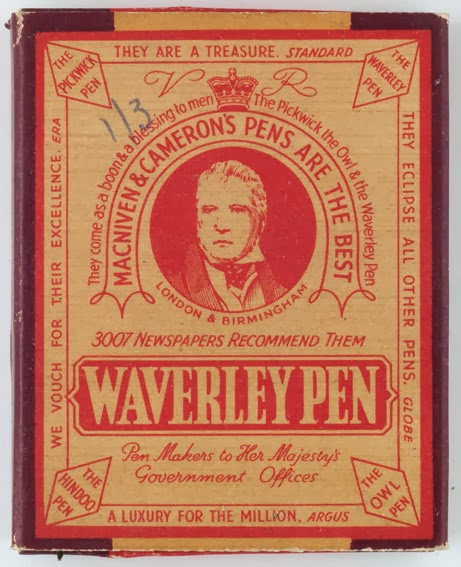
The creation of the Waverley nib is credited to Duncan Cameron, who in 1850 joined his brothers as one of the principals of the Scottish firm of Macniven and Cameron. This date has sometimes been confused with the date of the Waverley nib's introduction, some fourteen years later. Production appears to have begun in 1864, with a British patent for the turned up tip issued in 1865 and a US patent in 1867. Elements of this distinctive design were later copied by other makers of steel and bronze nibs, but the only gold fountain pen nibs made in this form were those used in Macniven and Cameron's own "Waverley" fountain pens -- though usually without the upward bend at the tip.
A few years ago, Richard Binder began to offer customized nibs with turned up tips, which he dubbed "Waverley" nibs as a tribute to Duncan Cameron and Macniven and Cameron. Unfortunately, this led to a bit of confusion, with some collectors and pen sellers wrongly assuming that "Waverley" could be used as a generic term for any nib with a turned-up tip.
In fact, the original Waverley was neither the first nib with its point turned up, nor the only. Nor was its name ever used to denote anything but an actual Macniven and Cameron Waverley nib. And let us not forget that at least some original Waverley nibs -- Macniven and Cameron's own gold fountain pen nibs -- dispensed with the turn-up entirely!
Wednesday, August 21, 2013
Korean faker pops up again
This may be a slight improvement over his earlier doings. Nonetheless, it is still flagrantly illegal in that the barrel bears a counterfeit (oh, sorry -- "reproduction") Parker Duofold imprint. Using registered trademarks without authorization is a big no-no, of course. We'll see how long before eBay steps in this time.
NOTE: Our faker is still using sunpawel as his user name; the last three of his "reproduction" Mandarin lots all went to the same buyer, fatnibs.