Silicone pen sacs are the future, and we now have them! Latex ink sacs have been around for over a hundred years, but have recently begun to show their age. Many newer ink formulations have proven rubber-unfriendly, turning conventional sacs to goo in a matter of months or even weeks. And as latex rubber ages, it can give off sulfur compounds that will permanently stain celluloids and other permeable plastics.
Silicone, by comparison, is remarkably resistant to chemical action, and highly resistant to taking a set (most materials, if squeezed long enough, won't spring back all the way after a while; silicone will). It's also very stable, so not only will it last a long, long time, it will not break down and release anything nasty as it ages.
Which brings up another issue: what about those other companies' silicone ink sacs? A good question, in that we have not yet been able to find any. Shocking, yes -- but when we started testing various sacs that were being advertised and sold as silicone, not a single one turned out to be as advertised. While some may have had some silicone content, their predominant ingredient was PVC -- otherwise known as vinyl. PVC can be a very durable sac material, but it is a potential time bomb in celluloid pens. As it ages, PVC exudes a plasticizer known to attack celluloid, leaving deep scars wherever contact is made. Unfortunately, in the past several years many collectors and repairmen have installed these "silicone" sacs in their most valuable and best-preserved celluloid pens, inadvertently replacing traditional latex sacs with something potentially much more damaging.
This disheartening discovery was what spurred us to get into the pen sac business, manufacturing top-quality ink sacs guaranteed 100% silicone. As we also discovered, making vinyl sacs is easy, but real silicone is another story. Genuine silicone sacs have to be injection molded. You can see the telltale mold lines running the length of our sacs (click on the picture above to enlarge). The absence of such lines is a strong indication that the sac is either dip or blow-molded, and not silicone -- no matter what the seller claims.
At the moment we have silicone sacs in only one size, #18, but we will be expanding the range of offerings considerably in the coming year. Sacs are now available for purchase through our catalog and on eBay. We will also soon be posting a video showing how to test a suspect sac to see if it really is 100% silicone.
PS Note that there is a big difference between silicone vulcanized at high temperature (as used in medical-grade tubing, for example, and our sacs), and RTV (Room Temperature Vulcanizing) silicones, familiar as sealants and molding media. Some RTV silicones release acids as they cure, which can be a prolonged process. This is not the case with high-temperature vulcanized silicones.
PPS The video on silicone sac testing and identification can now be seen here.
PPPS A chart laying out the pros and cons of various pen sac materials is here.
A blog about antique and vintage writing instruments: fountain pens, mechanical (propelling) pencils, dip pens, and more.
Tuesday, December 18, 2012
Thursday, December 13, 2012
Waterman and Aikin Lambert
It has long been known that Waterman at some point took over Aikin Lambert. When this took place, however, has long been an open question. Over ten years ago we noted that in Sheaffer's patent infringement suit against Barrett et al, Walter A. Sheaffer made a passing comment in his testimony of late May 1915 that Aikin Lambert was already in 1914 “a subsidiary company for the L.E. Waterman Company”. But when exactly did this takeover occur?
The American Stationer on July 14, 1906 describes what appears to be the turning point:
REORGANIZATION and reincorporation of the firm of Aikin, Lambert & Co., of New York, manufacturers of the Mercantile fountain pen, followed the sale of the interests of two members of the firm. The old charter of the firm under New Jersey laws expired and re-incorporation was affected under New York laws.
With the re-incorporation of the firm, two members of the old firm sold their interests, H. A. Lambert and John B. Shea. Mr. Lambert will continue with the firm until the first of next year, and is now on one of his trips through the West. John B. Shea, who was superintendent of the factory, has retired, and is no longer connected with the firm in any way.
John B. Shea sold his interest to W. I. Ferris of the L. E. Waterman Company, and Mr. Ferris now controls the stock which Mr. Shea has owned for years. When asked to say to whom the stock owned by Mr. Lambert was sold, a representative of Aikin, Lambert & Co. said that was a private matter, which had no interest for the public.
Numerous rumors have been afloat concerning the effect of the transfer of stock upon re-organization of the company. It has been said that interests controlling the L. E. Waterman Company had secured control of Aikin, Lambert & Co., but that is denied emphatically by both companies. It is said that Mr. Ferris bought the stock as an investment and that no other motive influenced him in the purchase. James C. Aikin is president and manager of the new company and will continue so indefinitely. No further changes are contemplated by any of the members, and the business is to be run in the future exactly as it has been in the past.
Monday, December 10, 2012
The Bookseller, Newsdealer and Stationer: another directory
The American Stationer is surely the most informative of the trade journals for historians of late 19th and early 20th-century writing instruments. There are other contemporary journals available online as well, however, and while their contents often overlap, it is worth consulting them all for the cases in which they do not. The Bookseller, Newsdealer and Stationer is probably the most useful of these, especially for periods when no copies of The American Stationer are available. It was published every two weeks, in two volumes per year (Jan-Jun and Jul-Dec).
Links are to Google Books; for advice on using them, please see our directory for The American Stationer. Corrections and additions are welcomed and invited.
1898 vol. 9
1899 vol. 10
1899 vol. 11
1904 vol. 20
1905 vol. 22
1905 vol. 23
1906 vol. 25 Dec 1 issue only
1907 vol. 26
1907 vol. 27
1908 vol. 28
1909 vol. 30
1910 vol. 32
1911 vol. 34
1911 vol. 35
1912 vol. 36 (another, no.2, Jan 15, only)
1912 vol. 37
1913 vol. 38
1913 vol. 39
1914 vol. 40
1914 vol. 41
1915 vol. 42
1915 vol. 43
1916 vol. 44
1916 vol. 45
1917 vol. 46 (another)
1918 vol. 47
1918 vol. 48 (another)
1919 vol. 49 (another, Jul 1-Aug 1 only)
1919 vol. 50
1920 vol. 51
1920 vol. 52
1921 vol. 53 (another, Nov 1 only)
Links are to Google Books; for advice on using them, please see our directory for The American Stationer. Corrections and additions are welcomed and invited.
1898 vol. 9
1899 vol. 10
1899 vol. 11
1904 vol. 20
1905 vol. 22
1905 vol. 23
1906 vol. 25 Dec 1 issue only
1907 vol. 26
1907 vol. 27
1908 vol. 28
1909 vol. 30
1910 vol. 32
1911 vol. 34
1911 vol. 35
1912 vol. 36 (another, no.2, Jan 15, only)
1912 vol. 37
1913 vol. 38
1913 vol. 39
1914 vol. 40
1914 vol. 41
1915 vol. 42
1915 vol. 43
1916 vol. 44
1916 vol. 45
1917 vol. 46 (another)
1918 vol. 47
1918 vol. 48 (another)
1919 vol. 49 (another, Jul 1-Aug 1 only)
1919 vol. 50
1920 vol. 51
1920 vol. 52
1921 vol. 53 (another, Nov 1 only)
Saturday, December 8, 2012
The American Stationer: a directory of online copies
For those researching the history of writing instruments, copies of The American Stationer (later, The American Stationer & Office Manager) are an invaluable resource. Many of the issues have been digitized and are available through Google Books, the Internet Archive, and HathiTrust, but there are some catches. One is that many volumes have yet to be scanned, while others are available only via Google's "snippet view". The other is that the majority of the volumes available through Google Books are accessible only from within the USA. Persistent researchers in other countries can have recourse, however, to a proxy server service, that makes it look as if one is browsing from a location within the USA. Tunnelbear is one such service that seems to get good reviews, and is free for up to 500MB of data per month.
George Kovalenko was the first to compile a public list of volumes available. It is posted at the Lion & Pen website, along with much of George's original research into these and other old periodicals [Not any more, thanks to the unfortunate demise of Lion & Pen - D.]. The list below started with my own directory of links, since finding the individual volumes within Google is (even for US residents) a bit of a nightmare. Most cannot be found by following links from other volumes; instead, one has to search for them individually, occasionally lucking out and finding a handful of links to other missing copies. The volumes available through the Internet Archive are much better catalogued, and I believe are also available worldwide without recourse to proxy servers.
Note that there was an error in volume numbering in 1919 (there is a second volume 84), and that in many cases more than one copy is available. The Internet Archive scans tend to be much higher resolution than the Google scans, and are also normally available for download in a much broader selection of formats. In general, the Google volumes can only be searched online. The pdf versions are great to have as references, but they are images only and cannot be searched -- a major drawback, imperfect as the OCR sometimes is on the scans. In a number of cases there are duplicate scans, usually of volumes both at the New York Public Library (NYPL) and the University of Illinois at Urbana (UI).
This is a work in progress. If you have any additions or corrections to contribute, they would be most welcome. The list follows below.
IMPORTANT UPDATE: As noted in the comments below, it appears that some of the HathiTrust copies are defective, with pages missing or mixed up that are present and in correct order in other online versions.
ALSO, it is important to note that the quality of the OCR varies tremendously in these volumes. Just because one has run a search on a volume for instances of "Waterman" does not mean that all instances will be returned. Manual page-by-page searching will often yield items missed by the search function, as illustrated by this post.
George Kovalenko was the first to compile a public list of volumes available. It is posted at the Lion & Pen website, along with much of George's original research into these and other old periodicals [Not any more, thanks to the unfortunate demise of Lion & Pen - D.]. The list below started with my own directory of links, since finding the individual volumes within Google is (even for US residents) a bit of a nightmare. Most cannot be found by following links from other volumes; instead, one has to search for them individually, occasionally lucking out and finding a handful of links to other missing copies. The volumes available through the Internet Archive are much better catalogued, and I believe are also available worldwide without recourse to proxy servers.
Note that there was an error in volume numbering in 1919 (there is a second volume 84), and that in many cases more than one copy is available. The Internet Archive scans tend to be much higher resolution than the Google scans, and are also normally available for download in a much broader selection of formats. In general, the Google volumes can only be searched online. The pdf versions are great to have as references, but they are images only and cannot be searched -- a major drawback, imperfect as the OCR sometimes is on the scans. In a number of cases there are duplicate scans, usually of volumes both at the New York Public Library (NYPL) and the University of Illinois at Urbana (UI).
This is a work in progress. If you have any additions or corrections to contribute, they would be most welcome. The list follows below.
IMPORTANT UPDATE: As noted in the comments below, it appears that some of the HathiTrust copies are defective, with pages missing or mixed up that are present and in correct order in other online versions.
ALSO, it is important to note that the quality of the OCR varies tremendously in these volumes. Just because one has run a search on a volume for instances of "Waterman" does not mean that all instances will be returned. Manual page-by-page searching will often yield items missed by the search function, as illustrated by this post.
Thursday, December 6, 2012
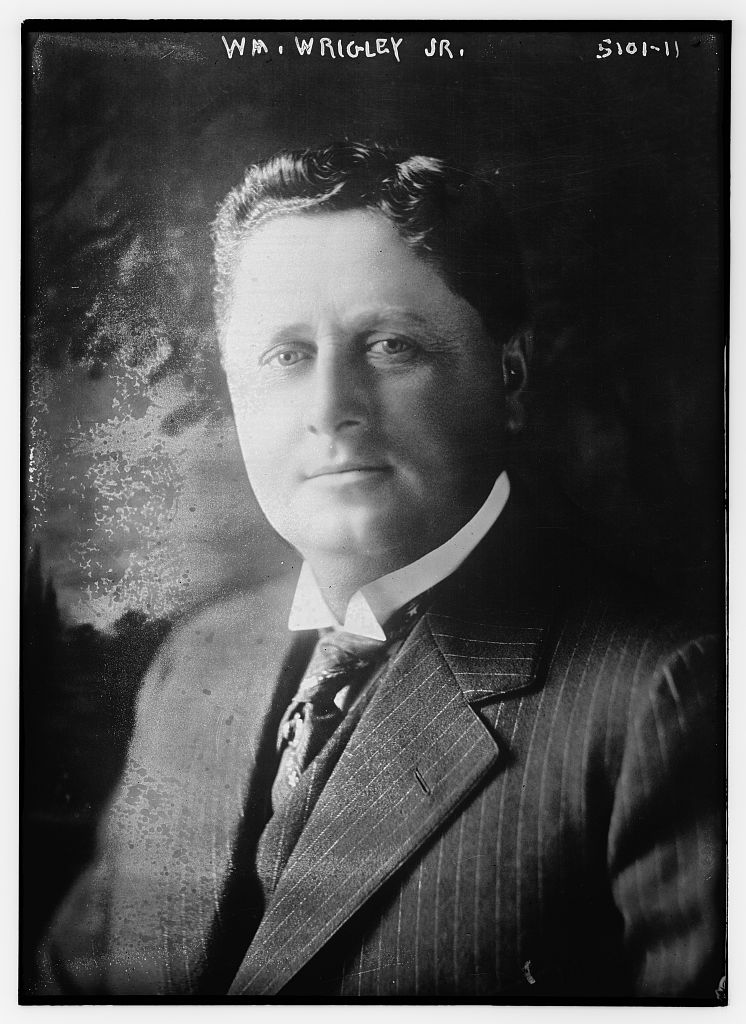
William Wrigley Jr.'s golden Wahl
This handsome little ringtop Wahl just joined our collection. It's solid 14K gold and nicely hand engraved, and it's also an eyedropper -- a design Wahl dropped from their line shortly after taking it over from the Boston Fountain Pen Company.
Even more notable, however, is the name engraved on the barrel: "Wm.Wrigley Jr./Chicago". Although the pen has no documentation of provenance, it was sold largely at gold value and there is no reason to think that the inscription was added falsely in order to enhance the pen's value.
William Wrigley Jr. (1861-1932) was a prominent figure, the founder of the Wrigley chewing gum company, owner of the Chicago Cubs, and namesake of Chicago's Wrigley Field. Wrigley was also the benevolent developer of California's Catalina Island, which he owned outright.
It was only appropriate that Wrigley owned a Chicago-made pen, and it would be interesting to find out if there were any business connections between him and the Wahl company, of the sort that have already been documented, for example, between Wahl and Montgomery Ward. The sharp-eyed may notice that the pen currently bears a Mabie Todd nib. A later replacement, to be sure, but perhaps still for the original owner. The pen itself must date to the late 'teens, and most likely was worn in a vest pocket at the end of a watch fob.
Before and after
A month back we posted this picture to our Facebook page. It shows a Waterman pen recovered from the recently-excavated wreckage of a WW2 Lancaster bomber, shot down in France on D-Day -- but one of many poignant relics of the lost crew (full story here).
The excavated pen is a relatively common Canadian-made Waterman model equipped with a rather uncommon clip: an top-mounted "military clip" (allowing the pen to be clipped inside a flap-top pocket, in conformity to military requirements), with the Waterman globe logo prominently displayed on top (and again, smaller, on the side).
Coincidentally, we were recently able to acquire an intact example of the same model, which is shown above. We now know the story of the excavated pen; what stories might this pen tell, if it could speak?
The excavated pen is a relatively common Canadian-made Waterman model equipped with a rather uncommon clip: an top-mounted "military clip" (allowing the pen to be clipped inside a flap-top pocket, in conformity to military requirements), with the Waterman globe logo prominently displayed on top (and again, smaller, on the side).
Coincidentally, we were recently able to acquire an intact example of the same model, which is shown above. We now know the story of the excavated pen; what stories might this pen tell, if it could speak?
Friday, November 30, 2012
From CNN (with video):
All you might feel is someone brush by you and a slight pin prick. But very quickly you would be suffering muscle paralysis followed by suffocation. You would be dead within a very short period of time. . .
Disguised to look like a Parker ballpoint pen, it contains a poison needle and is practically impossible to identify as a weapon.
Not for sale, luckily -- recently found in the possession of a North Korean assassin. He was also carrying a pen gun that resembled a Parker fountain pen, which shot a poisoned bullet, and a three-shot "flashlight". Apparently only the flashlight was new to South Korean intelligence, the other two devices having been around for some ten years or more.
ADDENDUM: To clarify, the two devices in their North Korean versions are of fairly recent date, but they are hardly new inventions. Both are decades old, and were Cold War staples. A recent episode of PBS' History Detectives was devoted to the development of the poison pin. Thanks to a faithful reader and correspondent for comments and the link.
Thursday, November 29, 2012
Doric photo inlays
Every so often one runs across an Eversharp Doric with a snapshot portrait set into its cap. We sold an example from our catalog a few months back; as far as I can recall, it was the first such pen we'd ever listed.
With exemplary timing, last week we were able to acquire a 1935-dated brochure promoting these photo inlays. How long they were offered is unknown; Eversharp catalogs do not mention them, and though I have a vague recollection of some other documentation having been published long ago, they remain a bit of a mystery.
A FEW FURTHER THOUGHTS: It is interesting that the brochure makes no mention of the cost of this service, nor of how one went about getting this personalized inlay. Was it available only on special order, or could it be done to a pen already made? On Dorics, it was surely done as part of the manufacturing process, for it would have been a delicate operation indeed to mill out a recess on the back of a Doric cap, inlay the photo and its clear cover, and then reshape the cover to match exactly and seamlessly the faceting of the rest of the cap. And if done in this manner, after the passage of decades the inlay would no longer match the rest of the cap so well as is observed in surviving examples. It should also be noted that Doric facets were not cut, but mold-formed under heat and pressure, making it all the more difficult to match a cap's original profile exactly by use of a cutting tool. Unfaceted pens and pencils would have been easier to retrofit with photo inlays, yet "easier" does not mean "easy". Seamless installation of an aftermarket inlay would have required considerable skilled hand labor, surely involving removal of the clip and re-turning of the cap on a lathe.
Given all this, Eversharp photo inlays must have been special-order, installed as part of the manufacturing process. Their cost was undoubtedly insufficient compensation for all the disruption they caused to a production line set up to turn out large quantities of identical components, not individual custom pens. My guess is that the photo inlays were dropped after a very short time indeed, though I'd be happy to be proved wrong by the discovery of any other advertising for them that significantly postdates the brochure shown above.
With exemplary timing, last week we were able to acquire a 1935-dated brochure promoting these photo inlays. How long they were offered is unknown; Eversharp catalogs do not mention them, and though I have a vague recollection of some other documentation having been published long ago, they remain a bit of a mystery.
A FEW FURTHER THOUGHTS: It is interesting that the brochure makes no mention of the cost of this service, nor of how one went about getting this personalized inlay. Was it available only on special order, or could it be done to a pen already made? On Dorics, it was surely done as part of the manufacturing process, for it would have been a delicate operation indeed to mill out a recess on the back of a Doric cap, inlay the photo and its clear cover, and then reshape the cover to match exactly and seamlessly the faceting of the rest of the cap. And if done in this manner, after the passage of decades the inlay would no longer match the rest of the cap so well as is observed in surviving examples. It should also be noted that Doric facets were not cut, but mold-formed under heat and pressure, making it all the more difficult to match a cap's original profile exactly by use of a cutting tool. Unfaceted pens and pencils would have been easier to retrofit with photo inlays, yet "easier" does not mean "easy". Seamless installation of an aftermarket inlay would have required considerable skilled hand labor, surely involving removal of the clip and re-turning of the cap on a lathe.
Given all this, Eversharp photo inlays must have been special-order, installed as part of the manufacturing process. Their cost was undoubtedly insufficient compensation for all the disruption they caused to a production line set up to turn out large quantities of identical components, not individual custom pens. My guess is that the photo inlays were dropped after a very short time indeed, though I'd be happy to be proved wrong by the discovery of any other advertising for them that significantly postdates the brochure shown above.
Wednesday, November 7, 2012
Post-Sandy outages
We are still having periodic power outages at the shop. The exact situation isn't clear, as the outages are unpredictable and affect the entire neighborhood. So far the main affect has been to slow down the listing of new items, but it has sometimes made us miss our shipping cutoff time, adding a day of delay in getting orders out.
PS All back to normal now (November 15), including our phone service which got rather scrambled by all the power fluctuations. We missed some days' worth of calls, as well as a number of voicemail messages -- so if you have been having trouble reaching us, please either call back or send us an email.
Thursday, November 1, 2012
Korean faker goes straight?
The Korean faker now selling on eBay under the username sunpawel has now taken a new tack. He has now listed a Parker Duofold Junior "parts kit" in Mandarin Yellow, the key bits being his newly-made yellow cap and barrel, complete with Parker imprint. The big difference is that this time he is not presenting a completed pen as original, but rather is openly advertising his parts as reproductions. He is also stating that the imprint is not laser-engraved, and instead "Is made to the original process."
While this is an improvement on brazenly selling outright fakes, this is still far from good. The parts are not marked as reproductions, and are still designed to deceive. Unsuspecting collectors are still going to end up paying good money for fake pens -- if not directly to the faker, to those who buy from him.
It is unfortunate that Parker still seems to show no interest in protecting their trademarks, for sunpawel's operation could be shut down in a hurry if only Parker sent its lawyers after him for misappropriation of the "Parker" and the "Duofold" names. Montblanc and Pelikan certainly wouldn't hesitate to act, as we have seen on numerous occasions.
While this is an improvement on brazenly selling outright fakes, this is still far from good. The parts are not marked as reproductions, and are still designed to deceive. Unsuspecting collectors are still going to end up paying good money for fake pens -- if not directly to the faker, to those who buy from him.
It is unfortunate that Parker still seems to show no interest in protecting their trademarks, for sunpawel's operation could be shut down in a hurry if only Parker sent its lawyers after him for misappropriation of the "Parker" and the "Duofold" names. Montblanc and Pelikan certainly wouldn't hesitate to act, as we have seen on numerous occasions.
Subscribe to:
Posts (Atom)