Saturday, January 18, 2014

Hard rubber parts manufacture

Many fountain pen manufacturers (and manufacturing subcontractors) did not vulcanize their own hard rubber. Those that did, however, had a considerable advantage over those who had to machine caps and barrels out of pre-made tube and rod stock. Instead, caps and barrels could be molded out of pliable raw rubber, hardened by vulcanization, and then finish-turned to final dimensions, minimizing both machining and wastage of material.

A good description of how this was done in is found in a 1905 article in Geyer's Stationer (vol. 39, Feb 16, pp. 7-10) which profiles Waterman's hard rubber factory:
After being thoroughly rolled the material is ready to be worked into shape. In order to make a barrel or cap the rubber, thoroughly warmed so as to have it pliable, is rolled on what is called a mandrel -- a shaft or spindle of iron with centers in each end upon which hollow work such as this rubber is driven for the purpose of turning the exterior. To form the closed end of the cap or barrel a small piece of rubber the size of the mandrel is placed at one end; then this little cap and the mandrel are wrapped together several times with a thin sheet of the rubber. Being hot, these parts of the rubber are thoroughly cemented as soon as they come together, leaving no air spaces and no leakage. This leaves the cap and the barrel perfectly tight at the lower end. The covered mandrel is then placed in the vulcanizer and subjected to steam heat of the proper temperature for a number of hours. After leaving the vulcanizer the metal rods are withdrawn from the rubber, and it is then ready for the turning lathe. The original mandrel leaves the hole the proper size for either barrel or cap, but the outside is made a trifle larger than the finished holder. This allows for turning down and removing any blemishes in order to give the surface a high finish.
The rough finish often seen on the inside of slip-on caps of the era would be consistent with manufacture as described, with little to no interior finishing after vulcanization. The account is somewhat inconsistent in that it first implies that the mandrels used in vulcanizing are also used to hold the parts for exterior turning, but then describes how the mandrels are withdrawn before sending the parts to the turning lathe. The latter procedure does seem more likely in a production environment, however, and especially if the machining operations took place in a location removed from the molding and vulcanizing work. Removing the mandrels would be much easier with the rubber still warm, and it would make more sense to leave another mandrel mounted on each lathe used for finish turning, onto which the blanks could be press-fitted.


It may not be so easy to see how the closed ends were formed when examining pen parts of unfaded black hard rubber. It is much more obvious with patterned, colored, or faded hard rubber, where breaks in the patterning and subtle color differences show where the end disk was inserted. In the big red hard rubber Williamson cap above, there is even a small gap where the material didn't join completely prior to vulcanization. While some pen components were made by cementing (or even vulcanizing) an end plug into pre-made tube stock after vulcanization, in such instances the plug will be perfectly round and precisely centered -- not the case here.


A more subtle example is the Waterman Ripple cap top above. The plug was made by slicing a disk from a spirally-wrapped rod. The plug is slightly darker so its circumference is readily apparent. Note, too, that were the entire cap to have been made from spirally-wrapped rod stock, the patterning would have been entirely different, with random mottling of the sort seen here.

Certain pen parts were nearly always made by being molded to shape prior to vulcanization. Taper caps, for example, are easily made by molding, but are tricky to machine out of solid stock. Oversized caps and barrels likewise can be molded with great efficiency, while hogging them out of solid rod is both time-consuming and hugely wasteful.

UPDATE: There is a much more detailed (and better illustrated) article on Waterman's manufacturing methods in the December 1911 issue of Machinery, pp. 249-53. And there is a companion article on the manufacture of gold pens (nibs) in the January 1912 issue, pp. 377-79.

Friday, January 17, 2014

A major Waterman history discovery

This week, George Rimakis and Daniel Kirchheimer have published a real blockbuster concerning the very beginnings of Lewis Edson Waterman's involvement in fountain pens. Their 33-page article, "Blotting Out the Truth", can be downloaded here in .pdf form.

A number of us have spent years digging into Waterman's origins; this is the great breakthrough. It has long been appreciated that most of the "official" stories were unreliable, if not pure fabrications: the ink blot; Waterman having to be persuaded to try advertising; Waterman moving straight from insurance to pens. As it turns out, Waterman ended up in the pen business almost by accident. It seems he was hired to sell the fountain pens of one Frank Holland, a Connecticut inventor whose backers had set him up in business in New York City. Holland was volatile, and after several weeks there was some sort of blowup and Holland walked out, leaving his backers in the lurch. Waterman then stepped in, fitting up Holland's pens with an improved feed. Success came rapidly, and Holland was soon forgotten.

While the authors describe what followed as a deliberate coverup, I'm not so certain. As I posted in a Fountain Pen Board thread:
I think that the case is pretty clear for the active shaping of the founding narrative after LEW's [Lewis Edson Waterman's] death. What happened during LEW's lifetime, however, is rather more complicated -- and interesting. No doubt that LEW was an aggressive operator, yet I'm not sure that his reticence about how he got into the pen business was entirely calculating and self-serving. Though Holland's backers might have felt that Waterman stole Holland's success, from the story as reconstructed, it seems Waterman was guilty of nothing more than picking up the pieces of what Holland threw away. And even then, the success he made of it was in very large degree due to his abandonment of Holland's feed, so there really is no question of unjust exploitation of any of Holland's patents. Nonetheless, there still would have been ample room for unpleasantness, and I wonder if LEW's silence about Holland had as much to do with discretion and decorum as anything else. It would have been impossible to talk about what really happened without making Holland look bad, and that would have reflected badly upon Waterman: one just didn't air dirty laundry in that way back then, and as Holland continued to self-destruct, it would additionally have been perceived as kicking a man when he was down -- however much his downfall was his own doing.
ADDENDUM: In case you rushed out and downloaded Rimakis and Kirchheimer's article as soon as you saw this post, do go back and download it again. The latest version has quite a bit more material on Frank Holland, and some additional illustrations.

Wednesday, January 8, 2014

Credit card processing changes

We are starting out the new year with some long overdue upgrades to our shopping cart gateway. If you are paying for orders with Paypal or by check, you won't see any changes. If you are paying with a card, however, you will be taken to a different screen when it comes time to enter your payment information -- so don't be concerned if the page footer identifies it as belonging to NMI/Strategic Payment Systems, for they are our processing service providers. One of the many benefits of the new system will be the elimination of the occasional problems we've had when accepting debit cards, which appear to have been entirely due to shortcomings of our old processing system.

Thursday, January 2, 2014

Waterman's cigar cutter


Not long ago, online research resources allowed us to pin down the story of how Waterman's legendary Prohibition Pen came to be. And now we have written documentation of another well-known Waterman rarity: the celluloid cigar cutter, shown above. The mention is in Geyer's Stationer (vol. 58, Mar 4, 1915, p. 15), citing the Seattle Rotary Club's February 22 Weekly Bulletin:
"Rotarian Frank D. Waterman, a member of the New York Rotary Club, contributed a very useful souvenir to those present, this being a combination envelope opener, cigar cutter and fingernail cleaner."
At first glance, I wasn't entirely certain about this reference. The cigar cutter's blade doesn't seem a very effective letter opener, nor much of a manicure tool.


Fortunately, there is one surviving example that retains its original box. And there is its official description: "Envelope opener, cigar cutter, nail cleaner" -- along with the personal imprint of Frank D. Waterman himself.


The Seattle Rotary meeting report allows us to place the Waterman cigar cutter, but likely as not the cutters were also given out at other times and at other events. Frank D. Waterman was an active Rotarian who traveled extensively; although Waterman cigar cutters are now rare, this may be a reflection of a low survival rate for an item that was both fragile and utilitarian. On the other hand, the slogan found on all known examples, "The Handiest Thing in the World", was not widely used in Waterman advertising, appearing in only a few ads and only in 1915.

Kut-No-Chek, the manufacturer, made similar promotional cutters for other clients. The company is listed at 1 Madison Avenue in New York City in Polk's New York Copartnership and Corporation Directory for 1915.

Saturday, December 28, 2013

Geyer's Stationer: a directory

The day will come when all of the old jewelry and stationery trade journals are available online. At present, however, availability is patchy, with gaps strategically located just where they most frustrate the researcher -- or so it seems. One such gap is in the run of the American Stationer between 1898 and 1905, but fortunately it can be at least partially filled in by Geyer's Stationer -- a very similar publication available through Google Books [and now HathiTrust as well -- D.], with only three 6-month gaps between 1900 and 1905. A full list, with links, follows. As usual, please let us know if you find any volumes not listed.


vol. 29, Jan-Jun 1900 (HathiTrust)
vol. 30 not available
vol. 31, Jan-Jun 1901 (HathiTrust)
vol. 32 not available
vol. 33, Jan-Jun 1902 (HathiTrust)
vol. 34, Jul-Dec 1902 (HathiTrust)
vol. 35, Jan-Jun 1903 (HathiTrust)
vol. 36, Jul-Dec 1903
vol. 37 not available
vol. 38, Jul-Dec 1904 (HathiTrust)
vol. 39, Jan-Jun 1905 (HathiTrust)
vol. 40, Jul-Dec 1905 (HathiTrust)
vol. 41, Jan-Jun 1906 (HathiTrust)
vol. 42, Jul-Dec 1906 (HathiTrust)
vol. 43, Jan-Jun 1907 (HathiTrust)
vol. 44, Jul-Dec 1907 (HathiTrust)
vol. 45 not available
vol. 46, Jul-Dec 1908 (HathiTrust)
vol. 47, Jan-Jun 1909 (HathiTrust)
vol. 48, Jul-Dec 1909 (HathiTrust)

vol. 51, Jan-Jun 1911 (HathiTrust)

vol. 53, Jan-Jun 1912 (HathiTrust)
vol. 54, Jul-Dec 1912 (HathiTrust)
vol. 55, Jan-Jun 1913 (HathiTrust)
vol. 56, Jul-Dec 1913 (HathiTrust)
vol. 57 not available
vol. 58, Jan-Jun 1915 (HathiTrust)
vol. 59, Jul-Dec 1915 (HathiTrust)
vol. 60 not available
vol. 61, Jan-Jun 1916 (HathiTrust)
vol. 62, Jul-Dec 1916 (HathiTrust)
vol. 63, Jan-Jun 1917 (HathiTrust)
vol. 64, Jul-Dec 1917 (HathiTrust)
vol. 65, Jan-Jun 1918 (HathiTrust)
vol. 66, Jul-Dec 1918 (HathiTrust)
vol. 67, Jan-Jun 1919 (HathiTrust)
vol. 68, Jul-Dec 1919 (HathiTrust)
vol. 69, Jan-Jun 1920 (HathiTrust)
vol. 70, Jul-Dec 1920 (HathiTrust)
vol. 71, Jan-Jun 1921 (HathiTrust)
vol. 72, Jul-Dec 1921 (HathiTrust)
vol. 73, Jan-Jun 1922 (HathiTrust)
vol. 74, Jul-Dec 1922 (HathiTrust
vol. 75, Jan-Jun 1923
vol. 76, Jul-Dec 1923
vol. 77, Jan-Jun 1924
vol. 79, Jan-Jun 1925
vol. 80, Jul-Dec 1925
vol. 82, Jul-Dec 1926
vol. 83, Jan-Jun 1927
vol. 84, Jul-Dec 1927
vol. 85, Jan-Jun 1928
vol. 86, Jul-Dec 1928
vol. 87, Jan-Jun 1929
vol. 88, Jul-Dec 1929
vol. 89, Jan-Jun 1930

Last updated 2206 EST, 15 Apr 2025

More on the introduction of the Clip-Cap


I've posted on Waterman's early clips here and here, and at the time had not found any mention of the Clip-Cap prior to July 1905. Now we can push back that date to April 20, the date of the issue of Geyer's Stationer in which the above ad appears (vol. 39, 1905, p. 11). All subsequent Waterman display ads in Geyer's show the Clip-Cap, even if they do not feature it to the same degree. The only material offered was German silver (aka nickel silver or cupronickel) until gold and silver versions are mentioned in the ad below, found in the July 20 issue (vol. 40, 1905, p. 11).

The ad refers interested dealers to the July issue of Waterman's Pen Prophet. Unfortunately, I do not have access to a copy, but if anyone wants to share theirs with me, I'd be happy to add its contents to this post.

PS It has been pointed out that the depiction of the clips in these early ads is distinctive, with squared-off tops -- unlike the rounded profiles of all known Waterman clips, but similar to the form shown in the patent drawings. Are these images actually representative of the very earliest Waterman clips, or are they artists' renditions that depend more on the patent drawings than on actual production samples? So far, no flat-topped Waterman clips have turned up. The first images of round-topped clips begin to appear in ads from the beginning of August 1905, and the last images of the flat-topped clips disappear after September -- though it should be noted that for years afterwards, Waterman ads often showed clips as more angular and less rounded than real-life examples.

Monday, December 23, 2013

A special-order Heath pencil


As soon as I put up the pictures of my Heath clutch pencils, a colleague wrote to ask about the one at the bottom -- in particular, the inscription at the top of the barrel, just below the crown. It reads, "Every Pound Pulls". This was the slogan used by the Concrete Steel Company of New York City to promote its patented "Havemeyer Bar" -- one of a number of competing forms of metal reinforcing bars used in reinforced concrete construction of the era.


The ad above (Engineering News-Record, vol. 69, Jun 19, 1913, p. 90) nicely illustrates its form, which is replicated in the relief patterning of the pencil's barrel and crown band.


PS Heath also made "Every Pound Pulls" dip pens; a nice boxed example was shown in an October 2024 Facebook post in the Antique Writing Instruments group.

Wednesday, December 18, 2013

Who designed the Eversharp pencil?

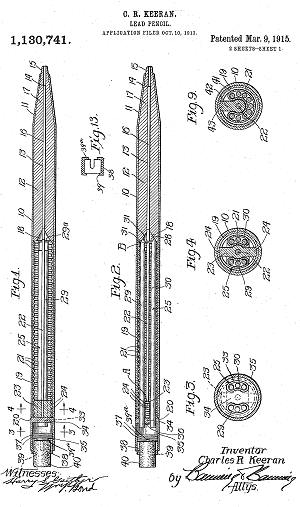
Up until recently, the answer would have seemed straightforward: Charles R. Keeran invented the Eversharp; the design must have been his. But as Jonathan Veley has pointed out, the appearance of the pencil shown in Keeran's first pencil patent is very different from our idea of an Eversharp. Instead of a metal tip, there is a wooden core, while at the other end there is an exposed eraser. Optional eraser covers are mentioned, but the designs shown in no way resemble the classic Eversharp's distinctive crown. All in all, this proto-Eversharp is most un-Eversharp in appearance. Note that no actual example of such a pencil is known, and the patent application for it was filed October 13, 1913.


The advertisement above was published in The Insurance Press of December 1912 (p. 83). By Keeran's own account, this was shortly before he first began thinking about an improved mechanical pencil. It would have been several months before his pencil patent application, and a full year before the first Eversharps were produced -- by Heath, by all evidence.


As the ad and the examples above show, Heath's clutch pencils have the Eversharp look, with the same proportions and the same distinctive crown. I had always thought that these pencils postdated Heath's involvement with Keeran. My reasoning was based upon the assumption that the Eversharp design was Keeran's, and that after Keeran and Heath parted ways, Heath must have borrowed the design for Heath's own pencils -- albeit only for pencils with a clutch mechanism, which clamped the lead, and did not mechanically push it out. Perhaps some components were left over from Heath's manufacturing work for Keeran, and perhaps some hadn't been paid for, allowing Heath to use them with a clear conscience -- or so I speculated.

The Insurance Press ad turns this all upside-down. Keeran invented the Eversharp's internals, but its "skin" was borrowed from a preexisting Heath product. We may never know exactly how Keeran's mechanism ended up being put into the Heath clutch pencil's body.  It might have been Keeran's idea; it might have been suggested by Heath while discussing how best to put Keeran's pencil into production. In any case, the resulting hybrid ended up eclipsing its progenitor. Heath likely didn't mind much, so long as it was producing both. Once Keeran switched production to Wahl it might have been a different story, but by then it was probably too late for Heath to do anything. I have not been able to find any patent for the Heath clutch pencil, either design or utility, even though one example, shown below, is marked "PAT. APP. FOR" on the barrel. This may explain why Wahl was in turn unable to prevent competitors from offering pencils that copied the Eversharp's appearance -- their number is striking, as is the closeness of resemblance.

ADDENDUM: More on the last pencil in the group of four shown in the picture above here.

Friday, December 13, 2013

Waterman pens with non-Waterman nibs

Starting with the earliest Waterman advertisements, supplying your own nib was repeatedly promoted as an customer option. As the ad above states: "contains one of the best maker's gold pens, or your favorite pen can be fitted". These nibs didn't have to be gold, either. As the Waterman's brochure of c.1892 (available through the PCA's Reference Library) states on page 4, "It [the Waterman pen] takes gold or steel pens of the ordinary straight forms, and your favorite pen (among these) can be fitted. Holders of corresponding sizes are made for gold pens from Nos. 1 to 9." There follows a discussion of the disadvantages of steel nibs in a fountain pen, as they must be swapped out at the end of each day as they are prone to rust, and on page 7 there are instructions on how to send in your own gold or steel nib to be fitted to a Waterman holder.

Not long after this, however, mention of other makers' nibs disappears. In Waterman's catalog of c. 1897 (so dated in the Reference Library, but possibly a year or so earlier) holder and nib sizes are cut down to five, from numbers 2 to 6, while emphasis is given to Waterman's ability to provide gold nibs to any taste. Exactly when this shift took place remains to be determined, though it seems likely that it coincides more or less with the introduction of the New Style (cone cap) holders in 1894; it is also plausible that it was not immediately rigidly adhered to, and that for some time afterwards, customers wishing to buy a Waterman pen would not be turned away if they insisted on bringing in their own favorite gold nib to be fitted.

All this is well known to serious Waterman collectors, but I recently came across a few references to Waterman pens with non-Waterman nibs that may be less familiar. The one below is an 1888 contest announcement printed in Stenography in the January, February, and March issues (pp. 5, 14, and 23).


"Gold mounted" would indicate the Waterman pen had gold filled barrel bands, and it is explicitly noted that it was fitted with a #5 Mabie Todd Stenographic nib. Another good example of special-purpose gold nibs taking precedence over the holders to which they were fitted is seen below.

This appears on page 7 of Benn Pitman and Jerome Bird Howard's The Reporter's Companion (Cincinnati, The Phonographic Institute, 1891). The special shorthand nibs -- from the imprints shown, probably made by John Holland or Weidlich -- are offered on their own, with a pocket dip holder, or fitted to a Waterman's fountain pen.

Finally, we have the ad above, from page 27 of the advertising supplement appended to the Gardeners' Monthly and Horticulturist, vol. 28, Jan 1886. It is in the name of Charles H. Marot, the publisher and owner of the Gardeners' Monthly, and it is safe to assume that it is entirely representative of how Waterman pens were sold at the time by authorized dealers. Regarding non-Waterman nibs, it is consistent with contemporary ads in stating: "USES gold or steel pens of the ordinary forms, and your favorite pen can be fitted" and "WE have holders for gold pens of numbers 3 to 8 inclusive, and for the common steel pen: also, an assortment fitted with gold pens ready for use." It is full of additional tidbits, however, such as the listing of holders by model numbers -- which at the time did not correspond directly with the nibs they carried -- and the provision of those holders' exact measurements. Perhaps most notable is the following statement:
"PRICES given are for well-finished 14 carat gold pens of the smallest size suited to the holder; 16 carat gold pens, or pens of the larger sizes, cost from 50 cents to $1.00 more. The 16 carat pens are of extra finish as as quality and are well worth the difference in price."
The extent to which nibs and holders were marketed as separate components is further highlighted by the very last line of the ad:
"A certificate may be had with each pen, which warrants the gold pens and holders for five (5) years, and guarantees both combined as a fountain pen, to give satisfaction on thirty days' trial or the money will be returned."
UPDATE: Waterman's Circular no. 55.26 can be dated right around 1901 from its back-cover trumpeting of the gold medal received at the 1900 Paris exposition, and from the 155/157 Broadway address (by the end of 1901, it had changed to 173 Broadway). And on page 7, we are told:
In ordering a gold pen and holder complete and ready for use, send a sample of writing and a description of the kind of pen desired . . .

In ordering a holder for a gold pen send the gold pen to be used, because the holder has to be adjusted to every gold pen, and we require these fittings to be done under our supervision.
 So as late as 1901, Waterman was still installing non-Waterman gold nibs upon customer request.

Dunlap patent stylographic pen

This stylo bears an imprint for Louis E. Dunlap's US patent of November 18, 1884, number 308,144. Dunlap had been the manager of Livermore's Stylographic Pen Company at 290 Washington Street in Boston, but appears to have struck out on his own in the midst of the what seemed to be a booming market for stylographic pens. The exterior of the pen is typical enough for stylographics of the era, but let's take a look inside.

The needle assembly is a press-fit into the point section. When pulled out, it is just as described and illustrated in the patent: a spring-loaded needle, with the spring action provided by a helically-cut section of hard rubber tube -- not vulnerable to corrosion, like a metal spring, nor likely ever to break from fatigue given the short working travel of the needle and the robust proportions of the hard rubber coil.


Advertisements and obviously-paid magazine writeups of the Dunlap pen appear in a burst in 1885. At some point in 1886 the ads stop appearing; the American Stationer for the second half of 1886 is not available online as yet, but there are several ads in the issues of the first half of the year, and none in the years following.


How long Dunlap remained in business is hard to tell. The company moved from its original address at 296 Washington Street in Boston to 280 Washington at the beginning of 1886 (American Stationer, vol. 19, Jan 28, 1886, pp. 93-4). The Boston Almanac and Business Directory for 1888 (vol. 53, p. 433; copyrighted in 1887) lists Louis E. Dunlap under "Pens" at 280 Washington, and the same entry -- just his name, in the "Pens" category -- appears in the following two years' volumes unchanged. The year after (vol. 57, p. 444, for 1892, copyrighted 1891) the address is 277 Washington, and in the two years thereafter the address changes to 7 Milk. I have not been able to find any mention of Dunlap in the American Stationer after 1886, so it seems probable that even if Dunlap continued to sell his remaining stock for some time afterwards, his company was really only a going concern for a couple of years. The pens are certainly not easy to find, though even with the imprints obscured, you can't mistake the interior construction. Dunlap later applied for a patent for an improved ink pellet, which was issued to him in 1897 (US patent 590,139)

Dunlap had assigned half of his stylographic pen patent to Herbert W. Thayer of Franklin, Massachusetts, so it is possible that Thayer was Dunlap's silent partner in the pen venture. Thayer later became involved in local and state politics, and he is described then as being a manufacturer (A Souvenir of Massachusetts Legislators, 1904, p. 162). Thayer died in 1908, trampled by a runaway horse startled by the sight of an electric car (New York Times, Jan 16, 1908).